
An EORI number is mandatory for anyone lodging a customs declaration in the European Union — art. 9 of Regulation (EU) No 952/2013, the Union Customs Code. In Poland the number is issued by the Director of the Tax Administration Chamber in Poznań through the PUESC platform, free of charge, normally within a few business days. One economic operator may hold only one EORI number, and it is valid across all 27 member states.
An EORI problem rarely looks like an EORI problem. It looks like this: the cargo has arrived at the terminal, the broker asks for the number to lodge the declaration, there is no number — and from that minute every day costs money. The goods sit in temporary storage, the carrier charges demurrage, and the Polish buyer is waiting for a delivery you have already confirmed.
Registration, meanwhile, is free and takes a few days. The only thing that matters is whether you started it two weeks before shipping or on the day the container was already on the quay. EORI is not a permit, it is an entry ticket: customs physically cannot accept a declaration without it, because the number field is mandatory.
In brief
- One operator, one EORI number for the whole EU (art. 9(2) of the Union Customs Code). A second number in another member state cannot be obtained, and attempting it ends in refusal.
- The number is issued free of charge. The only compulsory payment is PLN 17 of stamp duty on a power of attorney when a representative files.
- In Poland the issuing authority is the Izba Administracji Skarbowej w Poznaniu, Wydział Centralna Rejestracja, through PUESC. The application is form WRP0001 for a company and WRR0001 for an individual.
- Number format: PL + NIP + five zeros for a Polish company, and PL + 14 digits + the letter Z for an operator without a Polish NIP.
- A GB, US, Swiss or any other non-EU number is not an EU EORI. Since Brexit a GB number has had no standing in EU customs systems.
- The duty relief for consignments up to EUR 150 was abolished on 1 July 2026 — Council Regulation (EU) 2026/382 of 11 February 2026. A simplified rate of EUR 3 per item applies until 1 July 2028.
Who needs an EORI number and who does not
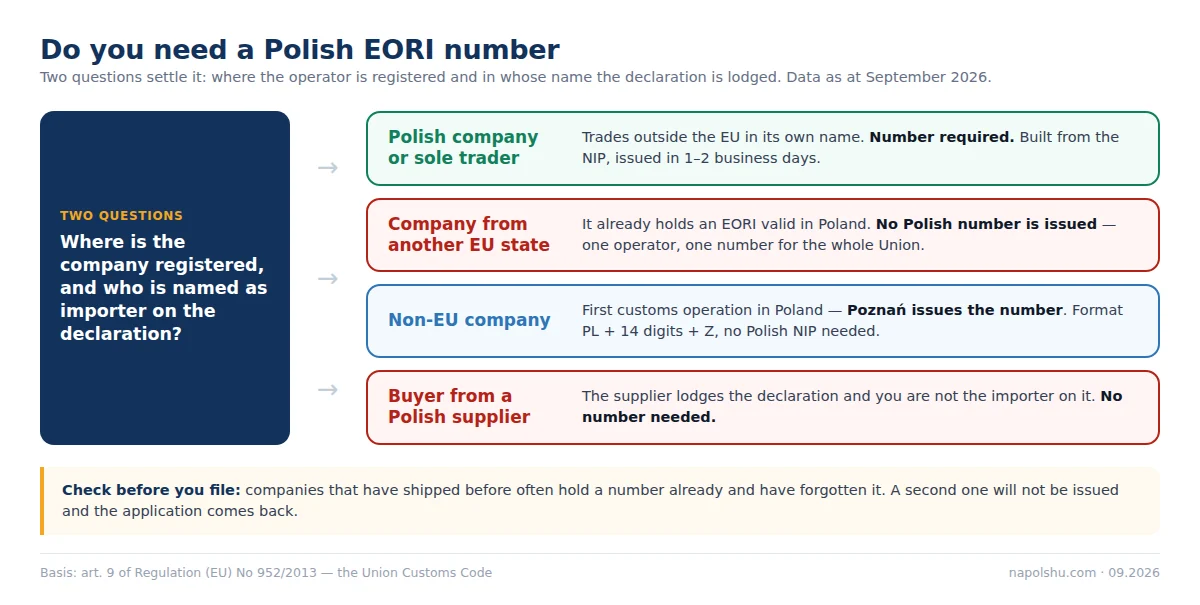
An EORI number is required by any person who deals with EU customs authorities in their own name: lodging declarations, applying for authorisations, receiving customs decisions. In everyday terms this reduces to “anyone moving goods across the Union’s border”, which is broadly right.
What matters more is knowing who does not need one, because that is where people most often pay for a service they do not need. A company registered in another EU member state does not obtain a Polish EORI: it already has its own, and that number works in Poland with no further steps.
| Your situation | Polish EORI needed | Why |
|---|---|---|
| Polish company importing from or exporting outside the EU | Yes | lodges declarations in its own name |
| Polish sole trader (JDG) trading outside the EU | Yes | same basis; number built from the NIP |
| Company registered in another EU member state | No | its own EORI is valid in all 27 countries |
| Non-EU company, first customs operation in Poland | Yes | the country of first operation issues the number |
| Non-EU company already holding an EU number | No | a second number is not issued |
| Individual bringing in goods for personal use | No | no commercial purpose |
| Individual importing commercially on a regular basis | Yes | treated as an economic operator |
| Marketplace seller shipping parcels into the EU | Usually yes | since 01.07.2026 parcels are no longer duty exempt |
The one-line rule: the number belongs to whoever is named as importer or exporter on the declaration. If you merely buy goods from a Polish supplier who lodges the declaration, you do not need one.
A GB or US number is not an EU EORI
This is the single most common misunderstanding among English-speaking clients, and it surfaces at the worst possible moment — when the goods are already at the border.
EORI is a Union number. It is issued by the customs authority of an EU member state under art. 9 of the Union Customs Code, and only such a number is recognised in EU customs systems. A GB EORI issued by HMRC has had no standing in the EU since Brexit; the same is true of Swiss, Norwegian, Turkish and any other third-country identifier, whatever it is called.
A British company shipping into Poland therefore normally holds two numbers: a GB EORI for the UK side and an EU EORI for the Union side. They are not interchangeable and they look different.
| Number | Valid in the EU | Comment |
|---|---|---|
| EORI issued by any EU member state | Yes, in all 27 | one operator may hold only one |
| GB EORI issued by HMRC | No | UK customs only, since 1 January 2021 |
| XI EORI (Northern Ireland) | Partly | used for Northern Ireland movements, not a substitute for an EU number |
| Swiss, Norwegian, Turkish identifiers | No | third-country registrations |
| EU VAT number | Not for customs | a tax identifier, not a customs one |
The practical consequence: if your first customs operation in the Union will take place in Poland — Gdańsk, Gdynia or a road crossing on the eastern border — the number should be obtained in Poland, not in whichever member state promised the fastest turnaround.
Signing from abroad: what PUESC accepts
PUESC accepts exactly three ways of signing: a qualified electronic signature, a Polish profil zaufany, and an advanced signature backed by a customs certificate. There is no fourth.
The good news for EU-based directors is that a qualified signature from any provider on the EU trusted list works in Poland directly, under the eIDAS Regulation. An Estonian ID card, an Italian firma digitale, a Spanish FNMT certificate — all of them sign a PUESC filing without any Polish credential whatsoever.
DocuSign and Adobe Sign are not qualified trust services in the eIDAS sense. They produce a perfectly enforceable commercial signature and are worth nothing at all in a Polish government system. The same applies to a scanned wet signature.
A profil zaufany requires a Polish PESEL number, which most non-resident directors do not have and do not need. For a company outside the EU with no EU-based signatory, the standard route is therefore a power of attorney to a Polish representative: signed by hand, filed through form DDS0001, with PLN 17 of stamp duty paid once per instrument.
| Method | What it requires | Works on PUESC |
|---|---|---|
| EU qualified electronic signature | provider on the EU trusted list | Yes, directly |
| Profil zaufany | a Polish PESEL number | Yes |
| Advanced signature with a customs certificate | certificate issued by the customs administration | Yes |
| Power of attorney to a Polish representative | signed instrument plus PLN 17 stamp duty | Yes, the representative signs |
| DocuSign, Adobe Sign, scanned signature | — | No |
| Non-EU national e-signature schemes | — | No, outside the eIDAS trusted list |
What an EORI number costs in 2026
Issuing an EORI number is free. That is the fact worth knowing before you speak to any intermediary: the state charges nothing for the number, and there is no paid fast-track procedure on PUESC.
One compulsory payment appears when a representative files on your behalf: PLN 17 of stamp duty on the power of attorney. It is paid once per instrument, not per filing.
| Item | Amount | Compulsory |
|---|---|---|
| Issue of the EORI number | PLN 0 | — |
| Stamp duty on a power of attorney | PLN 17 | yes, if a representative files |
| EU qualified signature, annual certificate | PLN 250–400 | no, if you hold a profil zaufany |
| Sworn translation of corporate documents | PLN 250–600 | yes, for a non-EU company |
| napolshu.com/ service | PLN 400 | no |
| VAT + VAT-UE + EORI package | from PLN 800 | no |
In short: the registration itself is free, and what you pay for is the filing going through correctly the first time. A defective application is not rejected instantly — it is examined for several days and only then queried. One wrongly completed section costs a week, not money.
Timing: how long the number really takes
The official PUESC wording is deliberately cautious: an application “may be verified over several days”. There is no statutory deadline here.
A good deal of English-language material still quotes 7–10 days. Those figures date from the era when registration ran through the separate SISC system and part of the checks were manual. Today a Polish company with an active NIP normally has its number within 1–2 business days, and delays almost always come down to three things: incomplete data on the form, a missing power of attorney, and foreign corporate documents without a sworn translation.
| Situation | What PUESC says | In practice |
|---|---|---|
| Polish company with NIP and a signature | “several days” | 1–2 business days |
| Polish sole trader | “several days” | 1–2 business days |
| Non-EU company, documents ready | “several days” | 2–5 business days |
| Non-EU company, translations still needed | — | add 2–5 days for translation |
| Query received from Centralna Rejestracja | — | add 3–10 days |
| Change of entity data (WRP0002) | “several days” | 1–3 business days |
Plan on a week before your first shipment, and two weeks for a non-EU company. A number obtained a day early costs nothing; a number obtained a day late costs a day of storage.
Getting an EORI through PUESC, step by step
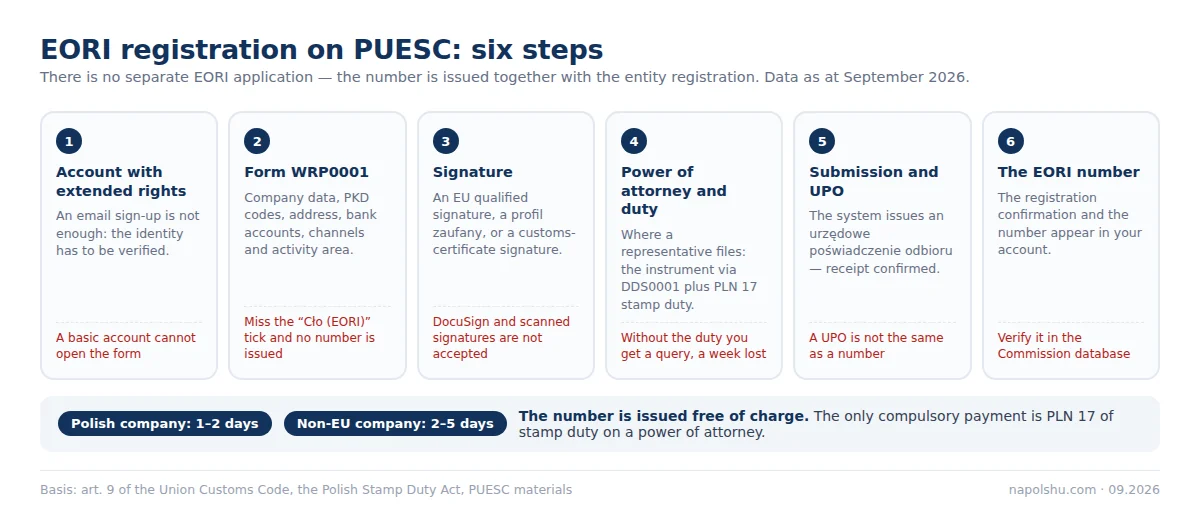
The whole process runs online through the Platforma Usług Elektronicznych Skarbowo-Celnych. There is no separate “EORI application”: the number is issued together with the registration of entity data, provided the activity area “Cło (EORI)” is ticked on the form. That single checkbox is the most commonly missed step in the entire procedure.
| Form | Purpose | Filed by |
|---|---|---|
| WRP0001 | entity registration and issue of the EORI number | company, sole trader |
| WRP0002 | change of data for an entity already registered | company, sole trader |
| WRR0001 | registration of an individual | individual |
| DDS0001 | supporting document: power of attorney, proof of stamp duty | applicant or representative |
- A PUESC account with extended rights. Signing up with an email address is not enough; the identity behind the account has to be verified.
- Form WRP0001. Entity data, legal form, PKD activity codes, address, contact details, bank accounts, communication channels and — this is the one — the “Cło (EORI)” activity area.
- Signature. An EU qualified electronic signature, a profil zaufany, or an advanced signature with a customs certificate.
- Power of attorney and stamp duty where a representative files. The instrument goes in through DDS0001 together with proof of the PLN 17 payment.
- Submission and UPO. The system issues an urzędowe poświadczenie odbioru, the official confirmation that the document has been received.
- Issue of the number. The confirmation of entity registration and the EORI number itself appear in your PUESC account.
What the number looks like and how to verify it
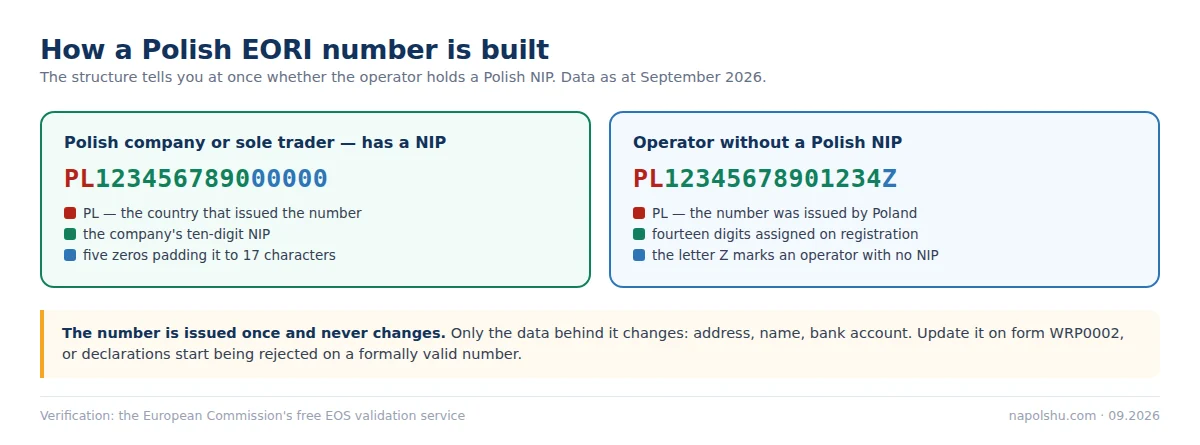
An EORI number follows the national rules of the country that issued it and always begins with that country’s code. A Polish number takes one of two shapes, and the shape tells you immediately whether the operator holds a Polish NIP.
| Operator | Structure | Example |
|---|---|---|
| Polish company or sole trader with a NIP | PL + 10-digit NIP + five zeros | PL123456789000000 |
| Operator without a Polish NIP | PL + 14 digits + the letter Z | PL12345678901234Z |
| Individual | PL + the identifier assigned on registration | — |
Any number can be checked free of charge in the European Commission’s validation service: it confirms whether the number is valid and, where the operator has consented, shows the name and address. The check takes under a minute and is worth running before a first shipment with a new counterparty — an invalid EORI means no declaration can be lodged in their name.
Non-EU companies: when Poland issues the number
The rule is straightforward: an operator not established in the customs territory of the Union registers in the member state where it carries out its first customs operation or first applies for a decision. If that is Poland, Poznań issues the number.
Such a company will need corporate documents with a sworn translation into Polish: an extract from the commercial register of its home jurisdiction, evidence of the signatory’s authority and sometimes the articles of association. Whether an apostille is required depends on the country and on the document — EU membership does not, by itself, exempt corporate documents from legalisation, and the EU regulation that removed it covers civil-status records rather than commercial register extracts.
| Document or condition | Required | Comment |
|---|---|---|
| Commercial register extract | Yes | with a sworn translation into Polish |
| Evidence of the signatory’s authority | Yes | from the extract or as a separate document |
| Polish NIP | No | the number is built without it, ending in Z |
| An address in Poland | No | the home-country address is enough |
| Power of attorney to a representative | In practice always | otherwise you need an EU-recognised signature |
| Customs representative for declarations | Yes | indirect representation, see below |
Parcels under EUR 150: the relief is gone
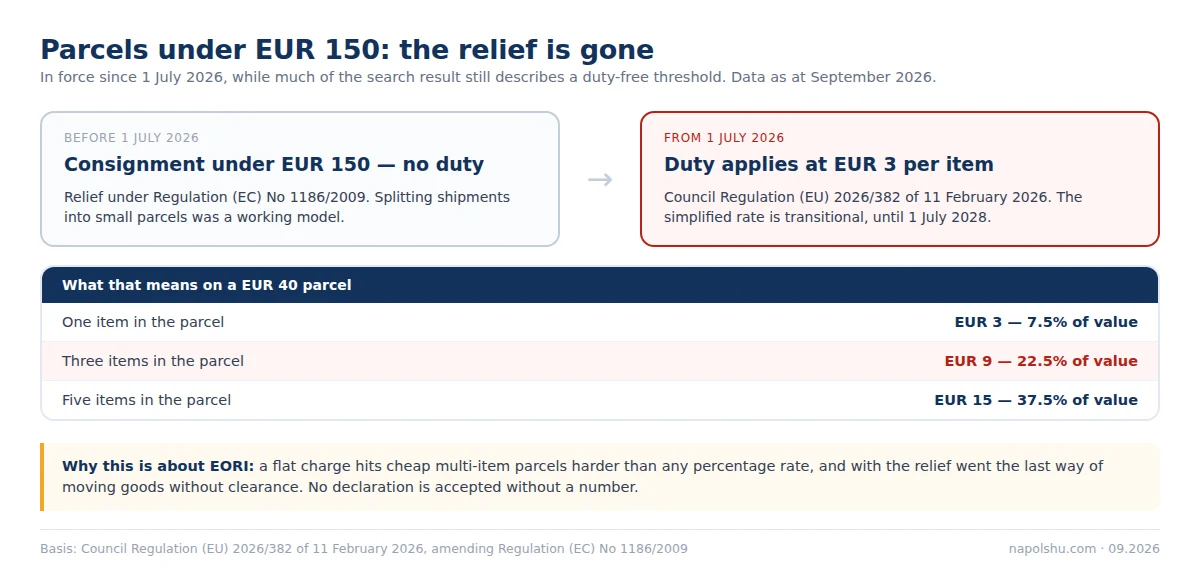
This is the most recent and the most widely missed change in the field. On 1 July 2026 the customs duty relief for consignments worth up to EUR 150 was abolished — Council Regulation (EU) 2026/382 of 11 February 2026, amending Regulation (EC) No 1186/2009 setting up the Community system of reliefs from customs duty.
Outdated information in search results. A large share of English-language material on importing into Poland still states that consignments below EUR 150 enter free of duty. As at 9 September 2026 that has been wrong for 70 days. The rule is Council Regulation (EU) 2026/382 and it took effect on 1 July 2026.
In place of the old relief, a simplified rate applies during the transition from 1 July 2026 to 1 July 2028: EUR 3 per item in the consignment. It covers postal consignments and imports exempt from VAT under the IOSS scheme.
A flat charge hits cheap multi-item parcels far harder than any percentage rate. A EUR 40 parcel containing three items: previously no duty at all, now 3 × 3 = EUR 9, or 22.5% of the goods’ value. The same EUR 40 in a single item costs EUR 3, or 7.5%. The only difference between the two is how the seller packed the shipment.
| Parameter | Before 1 July 2026 | From 1 July 2026 |
|---|---|---|
| Consignment up to EUR 150 | relieved from duty | dutiable |
| Transitional rate | — | EUR 3 per item, until 01.07.2028 |
| Imports under the IOSS scheme | no duty | duty at the simplified rate |
| Legal basis | Regulation (EC) No 1186/2009 | Council Regulation (EU) 2026/382 |
| Does the importer need an EORI | often no | as a rule, yes |
The upshot: business models built on splitting shipments into small parcels have lost their point, and with the relief went the last practical way of moving goods without customs clearance. For a seller outside the EU the EORI question has moved from “at some stage” to “before the next shipment”.
Get your EORI before the first shipment
We check whether a number has already been issued, assemble the documents, file WRP0001 and see the application through. For a Polish company that is usually 1–2 business days.
EORI and VAT: two numbers and the art. 33a procedure
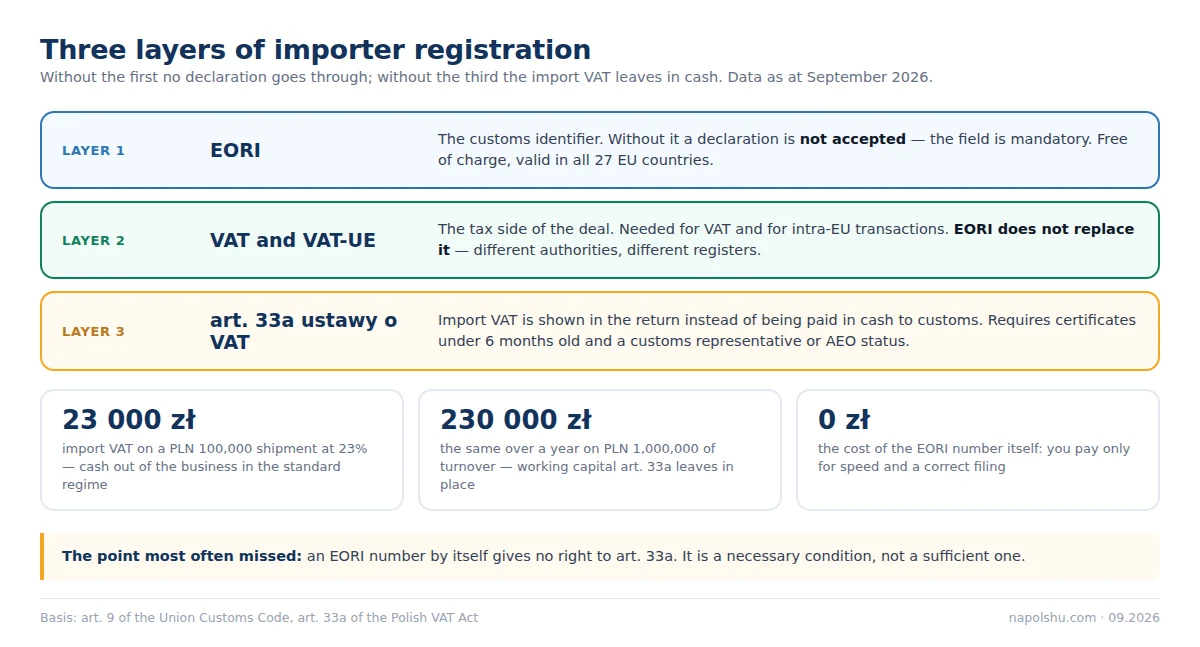
An EORI number does not replace a VAT-UE registration and confers no tax rights. They are separate registrations held by separate authorities: EORI by the customs administration, VAT by the tax office. An importer normally needs both.
The most valuable thing a properly built importer registration delivers is not the number itself but access to the procedure under art. 33a of the Polish VAT Act. In the standard regime import VAT is paid in cash to the customs account and recovered later through the return. Under art. 33a it is not paid in cash at all: the tax is shown as both output and input VAT in the same return.
In figures. An import of PLN 100,000 at the 23% rate means PLN 23,000 leaving the business and coming back weeks later. On PLN 1,000,000 of annual turnover that is PLN 230,000 of working capital. For a trading company this is the difference between growth and a permanent cash squeeze.
| Condition | Requirement |
|---|---|
| Taxpayer status | active VAT payer |
| Tax and social security arrears | none, or not more than 3% of the liability |
| Supporting certificates | issued no earlier than 6 months before the import |
| Alternative to certificates | declarations under criminal liability, art. 233 § 6 of the Criminal Code |
| Form of participation in clearance | through a customs representative, or holding AEO status or a simplifications authorisation |
| Return frequency | quarterly returns unavailable for at least 12 months |
| Correction window | 4 settlement periods, after which the tax is paid the ordinary way with interest |
So: an EORI number by itself gives no right to art. 33a. It is a necessary condition, not a sufficient one. That is why importer registration is worth planning as a whole rather than one form at a time.
Customs representation: direct and indirect
A customs representative is the agency or person who lodges the declaration for you. The difference between the two forms is practical rather than terminological: it decides who owes the customs debt.
Under direct representation the representative acts in the name of and on behalf of the importer, and the importer remains the debtor for duty and VAT. Under indirect representation the representative acts in its own name but on behalf of the importer, and becomes jointly and severally liable alongside it.
A company not established in the Union normally has no choice: it can only lodge declarations through an indirect representative. That also explains why Polish agencies ask non-EU clients for guarantees or prepayment of duties — their own money is on the line.
| Feature | Direct | Indirect |
|---|---|---|
| In whose name the representative acts | the importer’s | its own |
| Who owes the duty | the importer | importer and representative jointly |
| Available to a non-EU company | as a rule, no | yes |
| What the agency asks of the client | ordinary terms | guarantee or prepayment |
| Whose EORI appears on the declaration | the importer’s | both numbers |
Note the last row: a non-EU company needs an EORI number even when a Polish agency physically lodges the declaration, because its own number still appears on it.
ICS2 and NCTS: what changed on 1 June 2026
Alongside the duty reform, the filing systems themselves were changing. Poland used a derogation and accepted entry summary declarations under the previous rules until 31 May 2026. From 1 June 2026 ICS2 release 3 (step 3) and NCTS phase 6 are mandatory.
This has no direct bearing on getting an EORI number, but a great deal to do with what happens next: cargo data now reaches the European system before the goods reach the border, and every one of those messages carries the EORI numbers of consignor, consignee and carrier. An error in the entity data behind your number now surfaces before departure rather than at the terminal.
| Date | What happens |
|---|---|
| 19.06.2025 | AIS/IMPORT PLUS goes live for simplified declarations |
| 01.09.2025 | entry summary declarations may be filed directly in ICS2 |
| 31.05.2026 | last day of the previous entry summary declaration rules |
| 01.06.2026 | ICS2 release 3 (step 3) and NCTS phase 6 become mandatory |
| 01.07.2026 | duty relief for consignments up to EUR 150 abolished |
| 01.07.2028 | the transitional EUR 3 per item rate expires |
Your company details have changed
The EORI number itself is issued once and never changes. The data attached to it does have to be kept current: a change of address, name, legal form, bank account or contact details is reported on PUESC through form WRP0002.
Skip this and the number stays formally valid while declarations start being rejected for data mismatch. From the outside it looks like an inexplicable glitch: the number exists, it validates in the Commission’s database, and the declaration will not go through.
The update is free. It matters most after a change of registered address or management board in the KRS — data does not move between the registers automatically.
| What changed | Update needed | Consequence of not updating |
|---|---|---|
| Company address | Yes | mismatch with the declaration, filing refused |
| Company name | Yes | the same |
| Legal form | Yes | the same |
| Management board | Yes, where authorised signatories change | documents can no longer be signed |
| Bank account | Yes | problems with refunds and guarantees |
| The EORI number itself | Never changes | — |
Do individuals need an EORI number
An ordinary buyer ordering something for personal use does not need one: the postal or courier operator handles the clearance and no separate identifier is required.
That changes once the import stops being personal. Systematic buying for resale, regular shipments, a commercial purpose — and customs may treat the individual as an economic operator. An EORI number is then required and registration runs on form WRR0001.
The abolition of the EUR 150 relief also affects private recipients, but only as regards duty. It has not created any obligation for individuals to obtain an EORI number: the operator still handles clearance.
Common mistakes when filing yourself
| Mistake | Consequence |
|---|---|
| The “Cło (EORI)” activity area not ticked | entity registered, no number issued |
| Filing without a power of attorney and stamp duty | a query from Poznań, a week lost |
| Assuming a GB or other non-EU number will do | declaration cannot be lodged in the EU |
| Trying to obtain a second number while holding one elsewhere in the EU | refusal, art. 9 of the Union Customs Code |
| Starting registration after the goods have arrived | temporary storage charges |
| Signing with DocuSign or a scanned signature | nothing to sign the filing with, the case stalls |
| Foreign corporate documents without a sworn translation | the application is not examined on the merits |
| PUESC data not updated after a change of address | declarations rejected on a valid number |
| Assuming EORI gives access to art. 33a | import VAT leaves in cash |
The first row is the most common and the most galling: the applicant goes through the whole procedure, receives a registration confirmation and assumes the job is done. There is no number, and that only becomes apparent when the declaration is lodged.
How we work and what it costs
- We check whether a number already exists. Companies that have shipped before quite often have one, forgotten.
- We assemble the data for the form. From the KRS and CEIDG for a Polish company, from home-jurisdiction documents for a foreign one.
- We prepare the power of attorney and pay the stamp duty.
- We file WRP0001 with the “Cło (EORI)” activity area and collect the UPO.
- We run the application to issue, answering queries from Wydział Centralna Rejestracja.
- We hand over the number and confirmation and explain what comes next: VAT-UE, representation, art. 33a.
| Service | Price | Timing |
|---|---|---|
| EORI for a Polish company or sole trader | PLN 400 | 1–2 business days |
| EORI for a non-EU company | PLN 400 | 2–5 business days |
| VAT + VAT-UE + EORI package | from PLN 800 | 2–4 weeks |
| Updating entity data on PUESC | on request | 1–3 business days |
| Stamp duty on the power of attorney | PLN 17 | included |
Fifteen minutes to map your situation
We will tell you whether you need a Polish number at all, what has to be signed, how long it takes and which registrations you need besides EORI.
Further reading
- VAT registration in Poland — VAT-R, VAT-UE and timing
- Changes in the KRS — after an address change the PUESC data needs updating too
- A bank account for your Polish company — where VAT refunds land
- Company registration in Poland — if there is no Polish entity yet
Frequently asked questions
How much does an EORI number cost in Poland?
The number is issued free of charge — the customs administration makes no charge for it. There is one compulsory payment: PLN 17 of stamp duty on a power of attorney where a representative files. The napolshu.com/ service is PLN 400, stamp duty included.
How long does an EORI number take?
PUESC puts it cautiously: an application may be verified over several days. In practice a Polish company with an active NIP and an electronic signature has its number within 1–2 business days; a non-EU company takes 2–5 business days once the translations are ready.
Is my GB EORI number valid in the European Union?
No. A GB EORI issued by HMRC has had no standing in EU customs systems since 1 January 2021. An EORI number is a Union number issued by the customs authority of a member state under art. 9 of the Union Customs Code. A British company shipping into the EU normally needs both: a GB number for the UK side and an EU number for the Union side.
Do I need a separate EORI number for each EU country?
No. An operator may hold only one EORI number and it is valid in all 27 member states — art. 9 of the Union Customs Code. Applying for a second number in another country ends in refusal.
Can a non-EU company obtain an EORI number in Poland?
Yes, provided it does not already hold one anywhere in the Union. The number is issued by the country where the company carries out its first customs operation. No Polish NIP is needed: the number is shaped PL plus 14 digits and the letter Z. Corporate documents with a sworn translation into Polish are required.
Is it true that parcels under EUR 150 are no longer duty free?
Yes. The relief was abolished on 1 July 2026 by Council Regulation (EU) 2026/382 of 11 February 2026. A simplified rate of EUR 3 per item in the consignment applies during the transition until 1 July 2028. Sources still describing a EUR 150 duty-free threshold are out of date.
Can I sign the PUESC application with DocuSign?
No. DocuSign and Adobe Sign are not qualified trust services under eIDAS and carry no weight in Polish government systems. PUESC accepts an EU qualified electronic signature, a profil zaufany, or an advanced signature with a customs certificate. Where none of these is available, the usual route is a power of attorney to a Polish representative.
How is EORI different from a VAT-UE number?
EORI is a customs identifier; without it a declaration will not be accepted. VAT-UE is a tax number for intra-EU transactions. They are held by different authorities and neither substitutes for the other. A company importing from outside the EU and selling within it needs both.
Does an EORI number let me avoid paying import VAT in cash?
No. Accounting for import VAT in the return is the procedure under art. 33a of the Polish VAT Act, and it has its own conditions: active VAT payer status, no arrears, certificates no more than six months old, and clearance through a customs representative or AEO status. EORI is a necessary but not a sufficient condition.
This page is for information only and does not replace individual legal advice. Rules, rates and timings are stated as at September 2026.
Author: Marta Kowalik, lawyer at napolshu.com/. Verified on 9 September 2026. Sources: Regulation (EU) No 952/2013 (Union Customs Code), Council Regulation (EU) 2026/382 of 11 February 2026, the Polish VAT Act, the Polish Stamp Duty Act, PUESC and biznes.gov.pl materials, and the Tax Administration Chamber in Poznań.


