
Changes to the Krajowy Rejestr Sądowy (KRS) must be filed within 7 days
of the event — art. 22 of the ustawa o Krajowym Rejestrze Sądowym. The court fee in
September 2026 is PLN 250 when filing through the Portal Rejestrów
Sądowych (PRS) and PLN 200 through S24 where a model resolution is used.
The PLN 100 charge for the Monitor Sądowy i Gospodarczy announcement was abolished
on 29 November 2025.
Almost nobody in Poland meets the seven-day deadline, and for a while nothing happens.
The bill arrives later, and not from the court: the bank refuses to update the signature
card because the register still shows the previous board; a customer sees one address
on the invoice and another in the KRS and holds the payment; a notary declines to execute
a deed until the composition of the zarząd in the register matches reality.
Then a letter arrives from the court demanding the filing under threat of a fine.
The fee for a change is PLN 250. The fine under art. 24 of the KRS Act runs to PLN 15,000
per instance — sixty times more. All of it over one document that takes
an evening to prepare.
In short
- Seven days from the uchwała or other event giving grounds for the entry
(art. 22 of the KRS Act). The obligation sits with the management board, not the accountant. - PLN 250 through PRS, PLN 200 through S24 where a model resolution is used
(art. 55 of the ustawa o kosztach sądowych w sprawach cywilnych). - The MSiG charge was abolished on 29 November 2025 by the ustawa
z 26 września 2025 r. o zmianie ustawy o KRS. A change through PRS fell from PLN 350 to 250. - An application limited to updating PKD codes carries no court fee
(art. 20e of the KRS Act). From 1 January 2027 the codes are reclassified automatically,
and where no single match exists the objects clause is deleted from the register. - A qualified electronic signature from any EU trust service provider works
in both S24 and PRS under eIDAS. Signatures issued outside the EU do not, and a profil
zaufany requires a Polish PESEL number. - Two further deadlines survive the entry: 14 days for the CRBR beneficial
owner register and 7 days for form NIP-8 if the bank account, business addresses
or contact details changed.
Which changes must be registered in the KRS, and which must not
Only data disclosed in the register entry itself has to be filed: the company name,
the registered seat and address, the objects of the company, the share capital,
the composition of the zarząd and the manner of representation, prokura, shareholders
holding at least 10% of the capital, branches, and the address for electronic delivery.
Changing your accountant, your bank, your phone number or your website is not
registered in the KRS — none of that appears in the register of entrepreneurs.
Some of it goes to the tax office on form NIP-8, covered below.
| What changes | Notary required | Court fee, PLN | Filing deadline |
|---|---|---|---|
| Board member: appointment, removal, resignation | no | 200 via S24 / 250 via PRS | 7 days from the uchwała |
| Manner of representation | part of the articles — see below | 200 / 250 | 7 days from the uchwała |
| Prokura: granting and revocation | no | 200 / 250 | 7 days from the board uchwała |
| Address within the same locality | no | 200 / 250 | 7 days from the board uchwała |
| Registered seat — a different locality | part of the articles — see below | 200 / 250 | 6 months to file, 7 days in practice |
| Company name | part of the articles — see below | 200 / 250 | 6 months |
| Share capital: increase or reduction | part of the articles — see below | 200 / 250 | 6 months |
| Shareholder holding 10% or more | signatures certified by a notary | 200 / 250 | 7 days from the transaction |
| PKD codes within the objects clause | no | 0 when updating to PKD 2025 | by 31.12.2026 |
| Phone, website, accountant, bank | not filed with the KRS | — | NIP-8, 7 days |
One sentence from the table: whether a notary is needed is decided by the company’s
own history, not by the type of change — whether it was incorporated through S24
and still runs on model articles, or its articles have been amended before a notary at least
once. That is unpacked in the sections on S24 and PRS and on
address and registered seat.
What a KRS change costs in 2026
The court fee for changing an entry is PLN 250 when filed through the Portal Rejestrów
Sądowych and PLN 200 through S24 using a model resolution — art. 55 of the ustawa
o kosztach sądowych w sprawach cywilnych. There are no other mandatory court charges today.
| Action | Via S24, PLN | Via PRS, PLN |
|---|---|---|
| Change of an entry in the register of entrepreneurs | 200 | 250 |
| Updating PKD codes to the 2025 classification only | 0 | 0 |
| Filing documents to the court file separately | — | 40 |
| MSiG announcement of the entry | abolished 29.11.2025 | |
| Incorporation — for comparison | 250 | 500 |
| Suspension and resumption of business | — | 0 |
An outdated figure still circulating online. English and Russian language
pages on this topic keep quoting “PLN 100 for the Monitor Sądowy i Gospodarczy announcement”.
The publication requirement was abolished by the ustawa z 26 września 2025 r.
o zmianie ustawy o Krajowym Rejestrze Sądowym oraz niektórych innych ustaw,
in force since 29 November 2025.
In money: a change through PRS used to cost PLN 350 (250 fee plus 100 for the MSiG),
today PLN 250 — down 28.6%. Through S24 it was PLN 300, now PLN 200 — down 33.3%.
If a quote you receive still has an “MSiG” line, it was built on pre-November 2025 rules.
The total cost is driven neither by the court fee nor by what exactly you are changing,
but by whether a notary is involved — and that depends on the company’s history.
The matrix below shows it using a relocation as the example.
| The company’s route | New address in the same city | Move to a different locality |
|---|---|---|
| Incorporated through S24, articles never amended before a notary |
board uchwała, filed in S24, no notary PLN 950 |
model resolution, the articles change inside the system, no notary PLN 950 |
| Incorporated before a notary or amended notarially at least once |
board uchwała, filed through PRS, no notary PLN 950 |
notarial deed PLN 800–1200, consolidated text, sworn translation PLN 250–400, court fee PLN 250, our fee PLN 1200 PLN 2500–3050 |
One sentence: what costs money is not moving to another city, it is having notarial
articles. Three of the four cells cost the same PLN 950, and only the combination
of notarial articles with a change of registered seat produces a bill three times larger.
Deadlines: seven days to file, and how long the entry really takes
The application is filed within 7 days of the event — art. 22 of the KRS Act. The clock
starts on the date of the resolution, the agreement or another document, not on the day
the accountant heard about it.
A separate deadline governs amendments to the articles: six months from the date
of the resolution (art. 256 § 3 in connection with art. 169 § 1 of the Commercial
Companies Code). This is not slack, it is a point of no return. A resolution not filed within
six months produces no legal effect — so held the Supreme Court in its resolution of
29 April 2022. The notarial deed then has to be done, and paid for, a second time.
| Stage | What the law says | What happens in practice |
|---|---|---|
| Filing the application | 7 days from the event (art. 22 KRS Act) | a deadline for you; the court does not extend it |
| Amending the articles | 6 months from the resolution (art. 256 § 3 CCC) | once missed, the resolution is ineffective |
| Court review | 7 days from receipt (art. 20a(1) KRS Act) | from 5 working days to 2.5 months |
| Court review, S24 filings | 1 day (art. 20a(2) KRS Act) | usually 1–7 days |
| Re-filing after a return | 7 days from service of the order | keeps the original filing date |
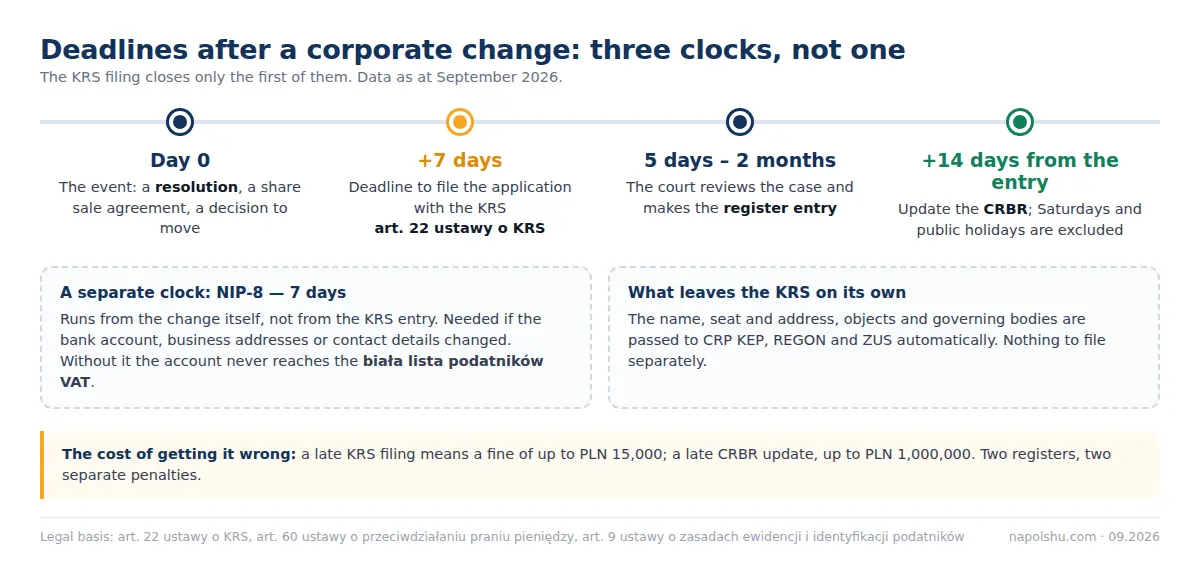
The seven-day review period is directory only: missing it carries no consequence for the court
and does not mean the entry is made automatically. The spread between divisions, and even
between cases in the same division, is wide.
One factor slows things down predictably: board members who are nationals of countries
outside the European Union. The court verifies the absence of convictions barring
them from office (art. 18 CCC), and that check takes longer. It is not a ground for refusal,
but it is a reason to build slack into your timetable.
S24 or PRS: which route applies to your company
The choice is not free — it follows from the company’s history. Since 1 July 2021 paper
filings to the register of entrepreneurs are not accepted at all: only S24 or the Portal
Rejestrów Sądowych.
S24 is available only to companies incorporated through S24, and only until the first
notarial amendment of the articles. After one notarial resolution amending the articles,
every subsequent filing goes through PRS. There is no way back.
| Feature | S24 | Portal Rejestrów Sądowych (PRS) |
|---|---|---|
| Who can use it | S24 companies with no notarial amendments | everyone |
| Fee for a change | PLN 200 | PLN 250 |
| Statutory review period | 1 day | 7 days |
| Document form | system templates only | any, including notarial deeds |
| Amending the articles | only within the template | no limits |
| Suspending business | not available | available, free of charge |
| Curing defects after a court notice | not available | here only |
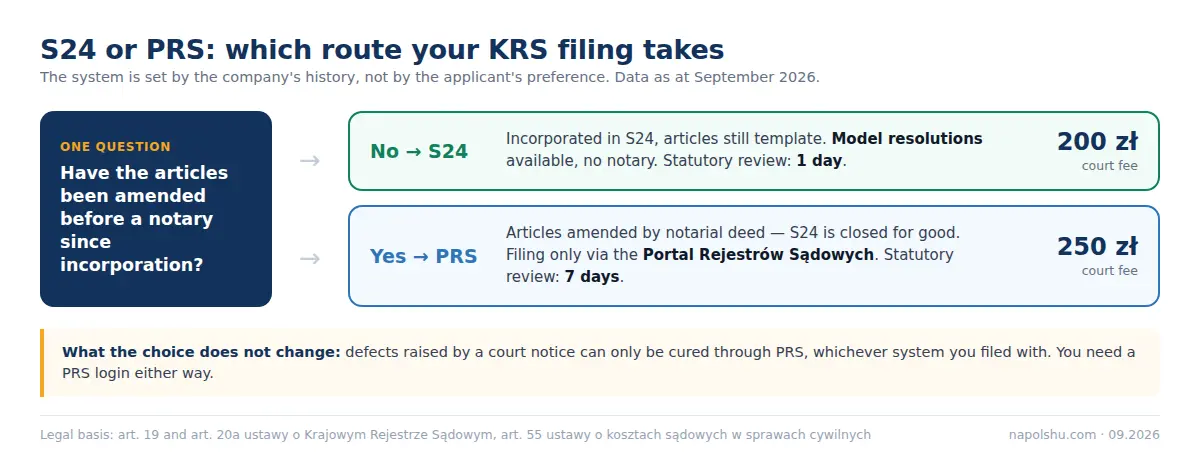
One sentence: S24 is faster and PLN 50 cheaper, but it only fits where the ready-made
template is enough — the moment you need non-standard wording in the articles, there is one
road, through PRS and a notary.
A practical detail people discover at the worst moment: defects raised by a court
notice can only be cured through PRS, whichever system you used for the original
filing. Set up your PRS login in advance.
Address or registered seat: what changes and what drives the cost
The registered seat (siedziba) of a Polish company is the locality named in its
articles. The address is the street, building and unit inside that locality.
Both are disclosed in the KRS.
The difference between them is one thing: moving within the same locality changes only
the address and is handled by a board resolution, while moving to a different locality changes
the seat and therefore changes the articles as well.
Amending the articles is not in itself what makes it expensive.
A company incorporated through S24, whose articles a notary has never touched, changes its
seat inside the system using the template — for the same money as an ordinary address change.
No notary is involved in either case.
What raises the price is notarial articles. If the company was incorporated
before a notary, or amended notarially even once, it no longer has template articles,
S24 is closed to it, and any amendment — including the seat — takes a notarial deed
with a consolidated text. That is the gap between PLN 950 and PLN 2500–3050 in Table 3.
What does not require a notary even for a company with notarial articles:
an address change within the city, and changes to the board or prokura. None of them touches
the articles; a resolution and a PRS filing are enough.
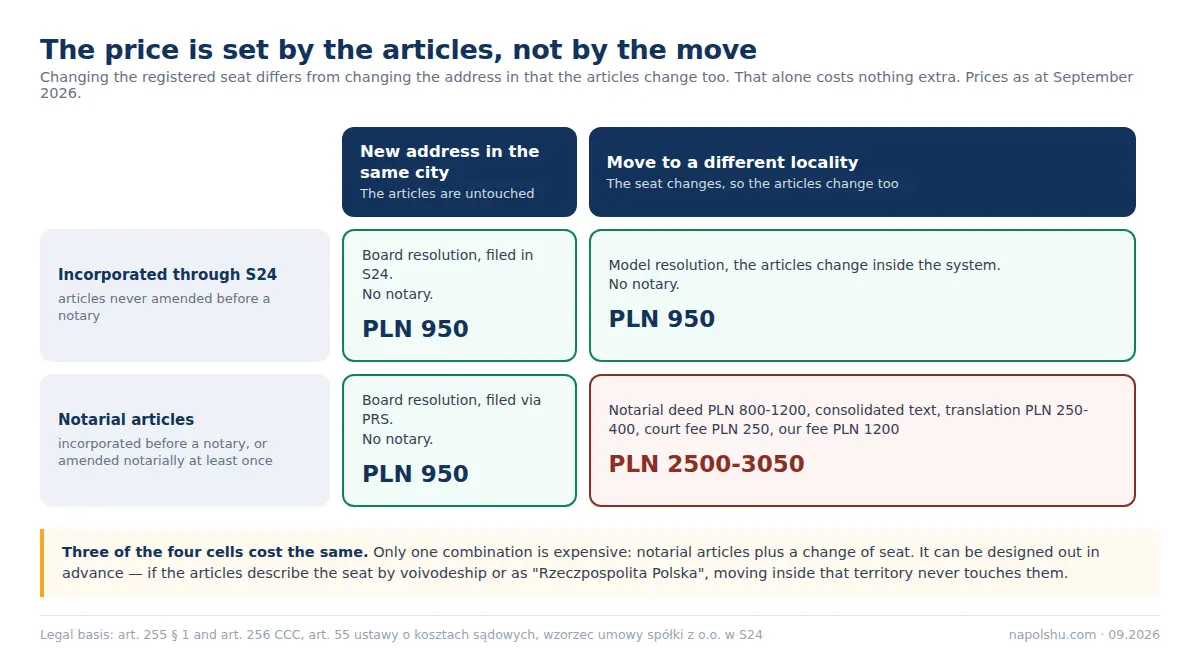
A drafting trick that saves the notary’s fee later. If the articles describe
the seat broadly — by voivodeship, or as “Rzeczpospolita Polska” — moving between cities
within that territory does not touch the articles and is handled by a single board resolution.
The wording is worth putting in at incorporation, or at your next visit to a notary,
rather than after the move has already happened.
Changing the board and prokura: what takes effect when
A new board member’s authority arises from the moment of the appointing resolution,
not from the register entry. The KRS entry is declaratory: it discloses the fact
to third parties and protects a counterparty acting in good faith, but it appoints and removes
nobody by itself.
Amendments to the articles work the other way round: there the entry is constitutive — the change
takes effect only when it is entered (art. 255 § 1 CCC). Until the court makes the entry,
the new capital and the new name do not legally exist.
The practical consequence for banks and counterparties: between the resolution and the entry
the company lives in two realities. The new managing director may already sign contracts,
but the bank will not let them near the account while the KRS extract still shows their
predecessor. That is why seven days is not a formality.
The filing on a board change is accompanied by: the resolution appointing or removing the member,
the new member’s consent to act together with their address for service, and, in a resignation,
the resignation statement itself. Updating addresses for service, incidentally, carries
no court fee.
“The most expensive mistake here is removing the only board member without appointing
a replacement in the same breath. The company is left with no body able to represent it,
the bank freezes the account, and putting it right takes weeks. Removal and appointment
always go in one resolution and one filing.”
Marta Kowalik, lawyer at napolshu.com
Selling shares and changing shareholders: the 10% threshold
Only shareholders holding at least 10% of the capital of a spółka z o.o. are disclosed
in the KRS. A new shareholder below that threshold does not change the entry —
which does not mean there is nothing to do.
The board must in any case file an updated shareholder list (lista wspólników) to the court
file, naming the shareholders and the number and nominal value of their shares — art. 188 § 3
of the Commercial Companies Code. Filed on its own, without an application to change the entry,
it costs PLN 40.
The transaction itself needs a specific form: a share sale agreement must be in writing
with signatures certified by a notary (art. 180 § 1 CCC). An ordinary signature
or a scan will not do — such a transfer is invalid.
Companies incorporated through S24 have a cheaper route: shares can be sold using the model
transfer agreement inside the system, signed with a profil zaufany or a qualified electronic
signature (art. 180 § 2 CCC). No notary is needed at all.
| Obligation | Who does it | Deadline |
|---|---|---|
| Notifying the company of the transfer | the parties | before the KRS filing |
| Shareholder list to the court file | the board | with the application |
| Application to change the entry if the stake reaches 10% | the board | 7 days |
| PCC-3 return and 1% transfer tax on market value | the buyer | 14 days from the transaction |
| Updating the CRBR beneficial owner register | the board | 14 days from the KRS entry |
One point foreign buyers routinely miss: the 1% transfer tax is due in Poland even when both
parties are non-residents and the money never touches a Polish account. The taxable base
is market value, not the price written in the agreement.
PKD 2025: 114 days before the codes are replaced for you
PKD 2007 codes remain valid in the KRS until 31 December 2026. As at
8 September 2026 that is exactly 114 days. After that date it is too late to do it yourself:
the system replaces them.
The mechanism sits in art. 20e of the KRS Act, added by the amendment of 21 November 2025.
It runs in three scenarios and only the first is harmless.
| Situation | What the system does | What it costs you |
|---|---|---|
| Exactly one new code matches the old one | replaces it automatically | nothing |
| Several codes match | picks one following GUS guidance | the register shows the wrong business profile |
| No single match exists | deletes the objects clause from the register | a company in the KRS with no stated objects |
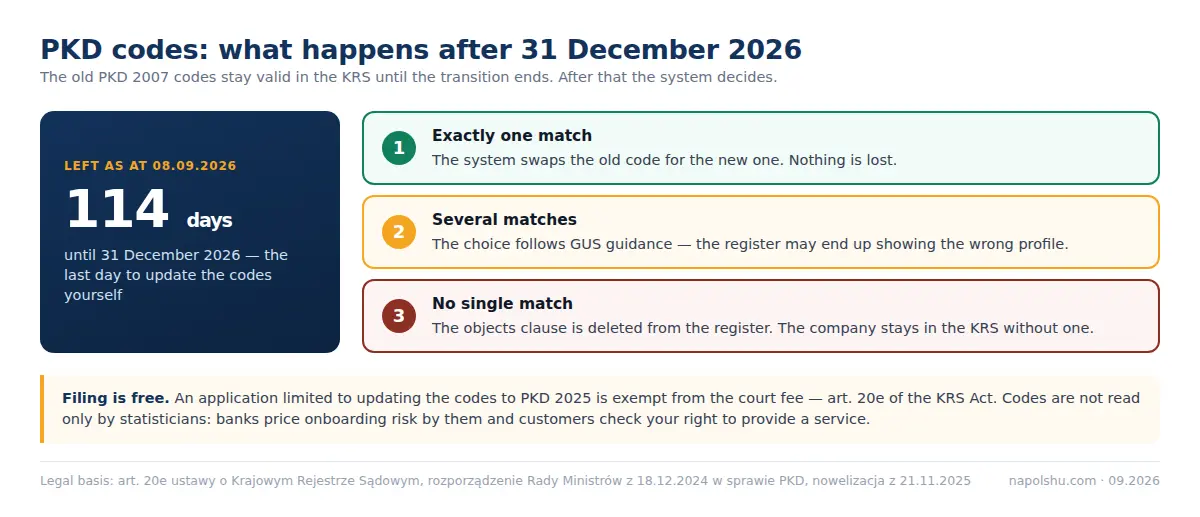
One sentence: automatic reclassification is not a service, it is the state’s insurance
against empty fields, and you do not control the outcome.
Why this matters more than it sounds. PKD codes are not read only by statisticians: banks price
onboarding risk by them, customers check whether you are entitled to provide a service,
and grant and tender committees screen applications by them. A company whose objects clause
has been deleted, or replaced by somebody else’s code, explains itself to each of them separately.
The good news is financial: an application limited to bringing the codes into line
with PKD 2025 is exempt from the court fee — expressly under art. 20e of the KRS Act.
You pay only for the preparation, and it makes sense to do it before the end of 2026.
Let us update your PKD codes before the deadline
We will read your KRS extract, pick PKD 2025 codes that match what the company actually does,
check the articles and file the application. No court fee applies.
After the KRS entry: CRBR, NIP-8 and the bank
The entry closes the court procedure but not the company’s obligations. Some data travels
from the KRS to other registers automatically, some does not — and the second half is where
companies lose money.
Transferred automatically from the KRS to the Central Register of Entities, to REGON and through
them to ZUS: the name, the seat and address, the objects and the composition of the governing
bodies. Everything else — the so-called supplementary data — is filed separately.
| What changed in the KRS | What else you must do | Deadline |
|---|---|---|
| Shareholders or ownership structure | update the CRBR | 14 days from the entry, Saturdays and public holidays excluded |
| Composition of the board | update the CRBR, replace the bank signature card | 14 days / per the bank’s rules |
| Address or registered seat | file NIP-8 with the business addresses, notify counterparties | 7 days |
| New bank account | file NIP-8, otherwise the account stays off the white list | 7 days |
| Company name | reissue invoices and contracts, notify the bank and ZUS | no formal deadline |
| PKD codes | check REGON and any licences still match | no formal deadline |
The CRBR deadline is 14 days from the date the change is entered in the KRS, and Saturdays
and statutory public holidays do not count towards it (art. 60 of the Polish AML Act).
The penalty for missing it runs to PLN 1,000,000, and that is not a theoretical figure:
decisions imposing it are published.
The biała lista podatników VAT deserves its own note. A bank account not
reported to the tax office on form NIP-8 never reaches that register, and a payment above
PLN 15,000 to an account outside it costs your customer the right to deduct it as a cost.
Large counterparties check this before every transfer.
What happens if you miss the deadline
Nothing happens automatically. The registry court first opens enforcement proceedings
(postępowanie przymuszające): it summons you to file within seven days on pain of a fine —
art. 24 of the KRS Act.
| Stage | What happens | What it costs |
|---|---|---|
| 1. Court summons | a demand to file within 7 days | PLN 0, but the clock is running |
| 2. Fine | imposed on board members, and repeatable | up to PLN 15,000 per instance |
| 3. Repeated fines | the court keeps imposing them until you comply | up to PLN 1,000,000 in total |
| 4. Dissolution without liquidation | the court may dissolve the company and strike it off | loss of the company |
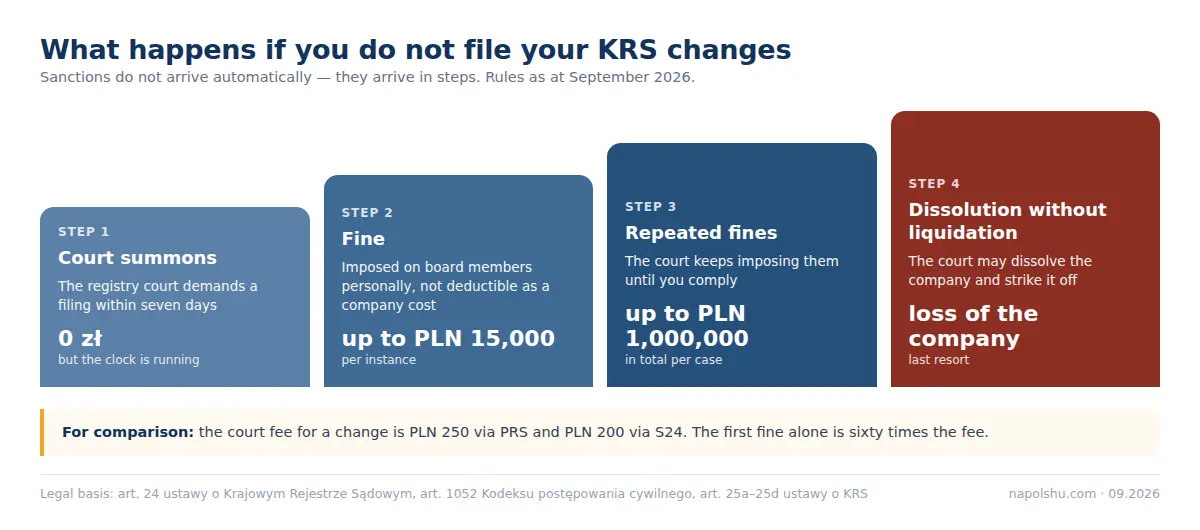
The ceilings come from art. 1052 of the Code of Civil Procedure, to which the KRS Act refers.
The fine falls on board members personally, not on the company, and is not deductible
as a company cost.
The more common damage is not the fine but the deal that stalls. An out-of-date KRS extract
blocks account opening, licensing, tender participation and any notarial transaction.
It is also what your counterparties across the EU see: the KRS is connected to the European
Business Registers Interconnection System, so a stale entry is visible well beyond Poland.
Signing from abroad: which electronic signatures Poland accepts
KRS applications are signed electronically — there is no paper signature in the system at all.
For a director who lives outside Poland this is the first practical hurdle, and the rules
are more generous than most people expect.
A qualified electronic signature issued by any trust service provider in the European
Union works in both S24 and PRS. That is the direct effect of the eIDAS Regulation:
an Estonian ID-card signature, an Italian firma digitale, a Spanish FNMT certificate or a German
qualified signature are all recognised in Poland without any additional step. You do not need
a Polish provider and you do not need a PESEL number.
Signatures issued outside the European Union are not accepted. That includes
Ukrainian qualified signatures and Diia, and it also includes the widely used commercial
e-signature platforms that are not qualified trust services — a DocuSign or Adobe Sign envelope
has no standing in the register whatsoever.
| Tool | PESEL needed | Cost | Where it works |
|---|---|---|---|
| Qualified signature from an EU provider | no | from PLN 239 net per year | the whole EU under eIDAS, including S24 and PRS |
| Profil zaufany | yes, mandatory | free, valid 3 years | Polish public systems, S24 and PRS |
| Podpis osobisty (Polish e-ID) | yes, plus a Polish ID card | free | Polish public systems |
| Non-EU signatures, DocuSign and similar | — | — | not accepted |
One sentence: if your director already holds a qualified signature from any EU member
state, nothing else is needed; if not, the cheapest path is a Polish qualified certificate
issued remotely after a video identification.
The third option is a notarial power of attorney authorising our representative in Poland
to sign and file. It is the usual answer for directors in countries where a qualified
certificate is not obtainable, and it requires a sworn translation into Polish.
Foreign documents: apostille, sworn translation and what the court asks for
Most KRS changes need no foreign documents at all. A board change, an address change
or a PKD update is filed on Polish-language resolutions signed electronically, and nothing
crosses a border.
Documents appear when a foreign company becomes or ceases to be a shareholder,
or when someone signs by power of attorney. Then two rules apply, in this order.
- Legalisation first. A corporate extract or a power of attorney issued
outside Poland carries an apostille under the 1961 Hague Convention. Some countries are
covered by bilateral legal-assistance treaties that remove the apostille requirement —
Ukraine among them — but that has to be checked case by case, not assumed. - Sworn translation second. The document and the apostille are
translated into Polish by a sworn translator entered on the Polish Ministry of Justice list.
A translation certified by a notary abroad is frequently refused.
The order matters and reversing it costs a second translation. Translate first
and the apostille arrives untranslated, and the court returns the set. Budget PLN 250–400
per document for the sworn translation and order two copies at once: the second is markedly
cheaper than the first, and institutions keep the original.
One question we are asked constantly: no, EU membership does not exempt corporate documents
from the apostille. The EU regulation that removes legalisation covers civil-status and similar
public documents, not commercial register extracts.
Common mistakes when filing yourself
The list is drawn from applications brought to us after a return or a court notice.
All five cost time, and two of them cost money.
| Mistake | Consequence |
|---|---|
| The resolution was passed by the wrong body | application returned, the procedure starts again |
| Filed without paying the court fee | returned without a notice to cure, the filing date is lost |
| Articles amended more than 6 months before filing | the resolution is ineffective, the notary is paid twice |
| KRS updated, CRBR forgotten | exposure to a fine of up to PLN 1,000,000 |
| Signed with a non-EU or non-qualified signature | the system rejects the file and the deadline runs out |
The wrong body. An address change within the city is the board’s competence,
yet we regularly receive minutes of a shareholders’ meeting — and the reverse: a change
of registered seat resolved by the board, although it amends the articles. The court returns
both.
The unpaid fee. An application filed without payment, or with errors
in the form, is returned without any notice to cure the defects. The good news:
re-filing within 7 days of service of the return order preserves the original filing date.
The bad news: almost nobody notices those seven days.
The six-month lapse. The most expensive of the five: the notarial deed
has to be commissioned again, PLN 800–1200 on top of what you have already spent.
The forgotten CRBR. The reasoning “the change is filed, so we are done” costs
more than everything else combined. The CRBR is a separate register with its own deadline
and its own penalty.
The wrong signature. The file is simply not accepted, while the signatory
believes the application has gone in. Check the certificate before the seven days start running.
From our own files: two thirds of the cases that reach us after a self-filing are not difficult
legal questions at all, but a mismatch between the wording of the resolution and the data
in the form. The court compares them literally: if the resolution says “ul. Prosta 51 lok. 12”
and the form says “ul. Prosta 51/12”, the application comes back. We reconcile both documents
before filing.
How we work and what it costs
napolshu.com has been handling KRS changes since 2001, from a single board member to a complete
restructuring of ownership. Most of our clients are companies whose shareholders and directors
sit outside Poland.
- We read the KRS extract. We establish what exactly changes, which body
resolves it and whether S24 is open to you. One working day. - We prepare the documents. Resolution, consents, shareholder list and,
where needed, draft amendments to the articles and a notary appointment. - We file through S24 or PRS and pay the court fee.
- We run the case to the entry. We answer court notices, cure defects and,
after a return, re-file within seven days so the original date holds. - We close the loose ends. We remind you about the CRBR, NIP-8 and the bank,
and send a fresh KRS extract.
| Option | What it covers | Price |
|---|---|---|
| Changes online, S24 | preparation, filing, PLN 200 court fee | |
| Changes via PRS and a notary | preparation, notary coordination, filing | |
| Updating PKD codes to 2025 | code selection, articles check, filing | PLN 950, no court fee |
| Notarial fees | paid separately at the notary’s tariff | PLN 800–1200 |
| Sworn translation | for foreign shareholders and directors | PLN 250–400 |
Tell us what needs to change
Answer four questions and we will show you which route your change takes, how long it runs
and what it costs. If the case is unusual, a lawyer will look at it by hand.
Further reading
- Apostille and legalisation for Poland — the order of steps and what a sworn translation costs
- A corporate bank account in Poland — what the bank asks for after a board change
- Company formation in Poland — when a new structure is simpler than a rebuild
Frequently asked questions
What does a KRS change cost in 2026?
The court fee is PLN 250 when filing through the Portal Rejestrów Sądowych
and PLN 200 through S24 using a model resolution. The separate charge for the Monitor
Sądowy i Gospodarczy announcement was abolished on 29 November 2025. Our fee starts
at PLN 950 including the court fee.
Can I sign the application with my own country’s electronic signature?
If it is a qualified electronic signature issued in an EU member state, yes —
eIDAS makes it valid in Poland, in both S24 and PRS, with no PESEL number required.
Signatures issued outside the EU are not accepted, and neither are ordinary e-signature
platforms such as DocuSign, which are not qualified trust services.
How long does the court take to register a change?
Under art. 20a of the KRS Act the court should review an application within 7 days,
and within one day for S24 filings. The period is directory: in practice entries are made
between five working days and two and a half months. Cases involving board members from
outside the EU take longer because of the criminal record check.
Can KRS changes be handled without travelling to Poland?
Yes. Applications are filed electronically only and personal presence is never required.
You need a qualified electronic signature or a profil zaufany. A trip is relevant only when
the change requires a notarial deed, and even then it can be done under a notarial power
of attorney.
What happens if I miss the seven-day deadline?
The registry court opens enforcement proceedings and summons you to file under threat
of a fine, under art. 24 of the KRS Act. The fine is imposed on board members personally,
up to PLN 15,000 at a time and up to PLN 1,000,000 in total. In the last resort the court
may dissolve the company without liquidation.
Why can’t I use S24 if the articles were amended before a notary?
S24 only works with documents built from its own templates. Once the articles have been
amended by notarial deed they are no longer template articles, and every later filing goes
through the Portal Rejestrów Sądowych. There is no way back into S24.
Do PKD codes have to be updated before the end of 2026?
There is no formal obligation to file, but PKD 2007 codes are valid in the KRS only
until 31 December 2026. From 1 January 2027 the system replaces them under art. 20e
of the KRS Act, and where no single match exists it deletes the objects clause from
the register. A voluntary update carries no court fee.
Does anything have to be filed with the CRBR after a KRS change?
Yes, if the change touched the beneficial owners: shareholders, ownership structure
or the composition of the board. The deadline is 14 days from the date of the KRS entry,
with Saturdays and statutory public holidays excluded. The penalty for missing it reaches
PLN 1,000,000.
The court returned my application — what now?
An application with errors or without payment is returned without any notice to cure
the defects. Re-filing within 7 days of service of the return order takes effect from
the original filing date, so the statutory deadline counts as met. Defects raised by a court
notice can only be cured through the Portal Rejestrów Sądowych.
This material is for information only and does not replace individual legal advice.
The rules and fees are stated as at September 2026.
Author: Marta Kowalik, lawyer at napolshu.com. Verified on 8 September 2026.
Sources: ustawa o Krajowym Rejestrze Sądowym, ustawa o kosztach sądowych w sprawach
cywilnych, Kodeks spółek handlowych, the Ministry of Justice fee schedule,
Regulation (EU) No 910/2014 (eIDAS).


