
Legal support since 2001
Polish criminal record certificate with apostille and translation
We obtain the zaświadczenie o niekaralności from the Krajowy Rejestr Karny, have it apostilled by the Ministry of Foreign Affairs and arrange a sworn translation — in the form the receiving institution will actually accept.
- A paper original is the only form an apostille can be placed on
- The electronic certificate works for Polish institutions only
- For another EU country no apostille is needed at all — we will say so
- Collected at the court counter on the day of filing, without you
- Office in Warsaw
- Reply within 15 minutes
- Sworn translation
- In practice since 2001
A Polish criminal record certificate costs PLN 30 on paper and PLN 20 electronically; an apostille from the Ministry of Foreign Affairs adds PLN 60 per document. The paper version is issued at a KRK counter in a court on the day of filing; the electronic one takes up to 20 calendar days. An apostille goes on the paper original only. Figures as at September 2026.
The difference between the two forms looks like ten złoty and decides the fate of the document. The electronic certificate arrives as an XML file, and its printout is not a document: it can be filed only with a Polish institution able to receive electronic documents. To a consulate, a foreign university or an employer abroad it goes nowhere.
Below: 2026 fees and timings, both forms compared, the answer to the question that actually matters — whether you need an apostille at all — and two sections written for an English-speaking reader: what to do if your record is British, and what the law requires from someone who has lived in several countries.
In brief
- The fee for a certificate from the Krajowy Rejestr Karny is PLN 30 on paper and PLN 20 through the e-KRK system. Basis: the rozporządzenie of the Minister of Justice of 18 June 2014.
- A printout of the electronic certificate is not a document. The MFA states plainly that no apostille is placed on a photocopy or on a printout from the ePUAP platform.
- An apostille costs PLN 60 of stamp duty per document and is issued by the MFA in Warsaw. No prior certification by a court is required.
- For another EU country no apostille is needed at all — Regulation (EU) 2016/1191 names “the absence of a criminal record” among the documents exempt from legalisation.
- The paper certificate is issued the same day; the electronic one takes up to 20 calendar days. Online here is the slower route, not the faster one.
- No statute sets a validity period. The receiving body sets it; in public procurement the certificate must be no older than six months.
In this article
- What a Polish criminal record certificate costs in 2026
- Electronic or paper: which one to order
- Ordering online: when it works
- The Polish certificate with an apostille: when you need one
- For an EU country no apostille is needed at all
- Certificate with apostille and translation
- If your record is British: the ACRO certificate
- If you have lived in several countries
- How to obtain the certificate: three routes
- Timings, and why online is the slowest route
- A certificate for a company: when it is needed
- Foreign nationals: what to do without a PESEL
- Working with children: what the Kamilek Act requires
- How long the certificate stays valid
- Common mistakes
- How we work and what it costs
What a Polish criminal record certificate costs in 2026
The state charges PLN 30 for a paper certificate and PLN 20 for an electronic one, and PLN 60 of stamp duty for each apostille. A separate item is the wielojęzyczny standardowy formularz, the multilingual standard form for EU countries, at PLN 17. The rates are set by the rozporządzenie of the Minister of Justice of 18 June 2014 on the fees for information from the Krajowy Rejestr Karny.
| Charge | Amount, PLN | Paid to |
|---|---|---|
| Certificate on an individual, paper | 30 | Ministry of Justice |
| Certificate on an individual through e-KRK | 20 | Ministry of Justice |
| Certificate on a company (podmiot zbiorowy) | 30 paper, 20 electronic | Ministry of Justice |
| Multilingual standard form for EU countries | 17 | Ministry of Justice |
| Apostille | 60 per document | Ministry of Foreign Affairs, stamp duty |
| Stamp duty on a power of attorney | 17 | urząd miasta; spouse, parents, children and siblings exempt |
The certificate fee is paid to the Ministry of Justice account, by electronic court fee stamps through oplaty.ms.gov.pl, or in cash at a court cash desk. Inside e-KRK payment is by card through the built-in service only. Doing it yourself, a certificate with an apostille costs the state PLN 90 — 30 for the document and 60 for the apostille. Everything above that is travel, queuing and time.
Electronic or paper: which one to order
Paper — if the document will go anywhere beyond a Polish government body. This is the decisive fork on this page, and the one people get wrong more often than everything else combined. The electronic certificate is ten złoty cheaper and looks more modern, but outside Polish state systems it does not work.
What you need to know about the electronic certificate. A document from the e-KRK system is issued as an XML file with an electronic signature. Its visualisation can be viewed and printed, but the printout is not a document — only the file itself has legal force. It can be passed on electronically and only to someone able to receive and verify such a file.
The MFA puts it even more bluntly: “Nie ma możliwości nadania apostille na kserokopii dokumentu ani na wydruku z platformy ePUAP” — no apostille on a copy or on a printout. The electronic certificate and an apostille are incompatible in principle.
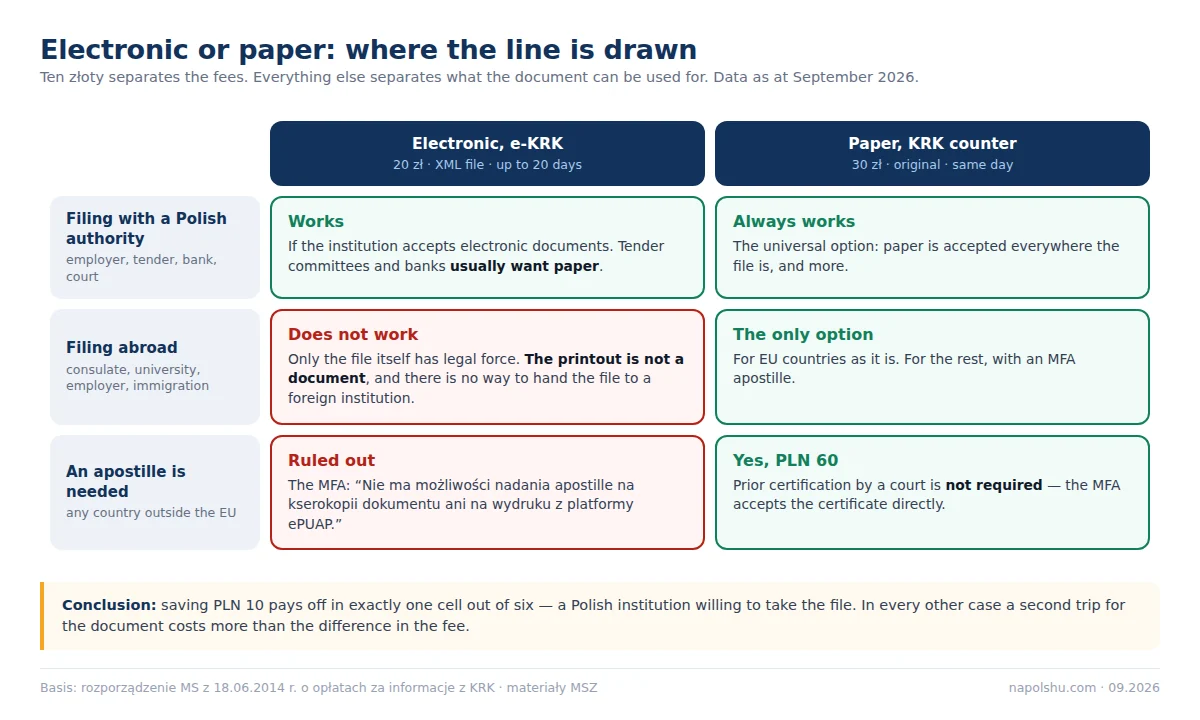
| Where you are filing | Electronic, PLN 20 | Paper, PLN 30 |
|---|---|---|
| A Polish authority that accepts electronic documents | works | works |
| A Polish employer | only if they agree to take the file | always works |
| Tender, bank or licence in Poland | paper is usually required | works |
| An institution in another EU country | does not work | works, no apostille needed |
| A country outside the EU, consulate, immigration | does not work | works, apostille needed |
| Any case where an apostille will be required | ruled out | the only option |
The conclusion in one line: saving PLN 10 makes sense in exactly one case — when the document stays inside Poland and is filed electronically. In every other case the paper original is cheaper, because a second trip for the document costs more than the difference in the fee.
Ordering online: when it works
Ordering online works if you hold a profil zaufany (the Polish trusted profile) or a qualified electronic signature, and the document is for a Polish institution. The application is filed in the e-KRK system, signed by one of those two means, and the PLN 20 fee is paid by card inside the service.
Then come the limits that most sources leave out. A profil zaufany requires a PESEL number, and since 1 January 2026 a third-country national obtains a PESEL only by appearing in person at a gmina office — art. 18 ust. 1a of the ustawa o ewidencji ludności. So for many foreign nationals the online route is closed not by the certificate but by the missing key to the door. See our page on the PESEL number for foreigners.
| Route | How the application is signed | PESEL needed | What you receive |
|---|---|---|---|
| The e-KRK system | profil zaufany or a qualified EU signature | yes, if via profil zaufany | a signed XML file |
| A KRK counter in a court | a wet signature on the form | no, an identity document is enough | a paper original |
| By post to the KRK | a wet signature | no | a paper original |
| Through a representative under a power of attorney | the principal’s signature | no | a paper original |
The conclusion in one line: online is the route for someone who lives in Poland, holds a PESEL and is filing with Polish authorities. For everyone else the answer is paper, and doing it remotely is simpler through a representative than setting up a profil zaufany for the sake of one certificate.
The Polish certificate with an apostille: when you need one
An apostille is needed when the document is filed in a country that is party to the Hague Convention of 1961 and is not an EU member state. It is issued by the Polish Ministry of Foreign Affairs, at PLN 60 of stamp duty per document. For a KRK certificate no prior certification by a court is required — the MFA accepts it directly.
In practice it works like this. The original is filed in person at ul. Krucza 38/42 in Warsaw by appointment, and the matter is dealt with during the visit. Documents sent by post go to al. Szucha 23, 00-580 Warszawa, and the MFA handles such requests within 30 days of receipt. The difference between the two routes is a month, which is why the apostille is usually arranged through a representative in Warsaw.
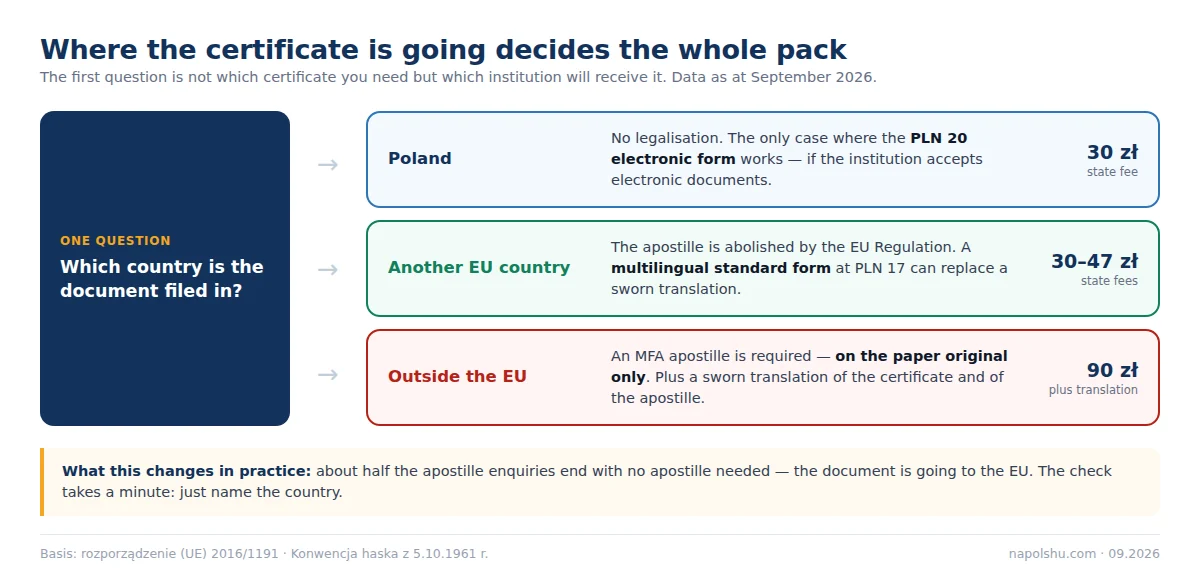
| Where the document is going | Apostille | Basis |
|---|---|---|
| A Polish institution | not needed | domestic document |
| An EU country: Germany, Czechia, Italy, Spain and the rest | not needed | Regulation (EU) 2016/1191 |
| The United Kingdom, Switzerland, Norway | needed | Hague Convention 1961 |
| The United States, Canada, Australia, New Zealand | needed | Hague Convention 1961 |
| A country outside the Hague Convention | no — consular legalisation instead | bilateral procedure |
The conclusion in one line: establish the destination country first, and only then order an apostille. Half the enquiries we receive about an apostille on this certificate end with us not issuing one: the document is going to the EU and is accepted there without it.
For an EU country no apostille is needed at all
Regulation (EU) 2016/1191 of the European Parliament and of the Council abolished the apostille and legalisation requirement for a range of documents between EU member states, and “the absence of a criminal record” is named in it expressly. A Polish certificate is filed with an institution in any Union country as it is — that institution has no right to demand an apostille.
The second half of the Regulation deals with translation. A wielojęzyczny standardowy formularz — a multilingual standard form issued by the same authority that issued the document, costing PLN 17 — can be attached. It serves as the official translation and removes the need for a sworn translator. One caveat: the form has no legal value on its own, separated from the document it was issued for, so there is no point filing it alone.
| Destination | What you need | State charges, PLN |
|---|---|---|
| A Polish institution | the certificate | 30 |
| An EU country, language matches | the certificate | 30 |
| An EU country, translation needed | certificate and multilingual form | 47 |
| Outside the EU, English translation | certificate, apostille, sworn translation | 90 plus translation |
| Outside the EU, apostille on the translation too | certificate, apostille, translation, second apostille | 150 plus translation |
The conclusion in one line: the pack for Germany costs PLN 47 in state charges, the same pack for Canada at least PLN 90 plus translation. The difference of nearly double comes not from the document’s complexity but from one line in a European regulation.
“The most common conversation on this service is with someone already reaching for their card to pay for an apostille, when the document is going to the Netherlands. We explain that it will be accepted there as it is, and sell a PLN 200 certificate instead of a PLN 450 pack. Those clients come back more often than any others.”
Marta Kowalik, lawyer at napolshu.com/Certificate with apostille and translation
Where a certificate with an apostille and a translation is required, both documents have to be translated — the certificate and the text of the apostille. This is the most common reason a finished pack comes back: the translation covers the certificate only, the apostille is still in Polish, and the receiving institution treats the pack as incomplete.
Hence the rule on sequence: apostille first, translation second. Translate earlier and the apostille lands on the original after the translation was made and never appears in it, so a second translation is needed. The reverse order is right only where the institution wants an apostille on the translation itself: then the chain runs to four steps and two visits to the MFA.
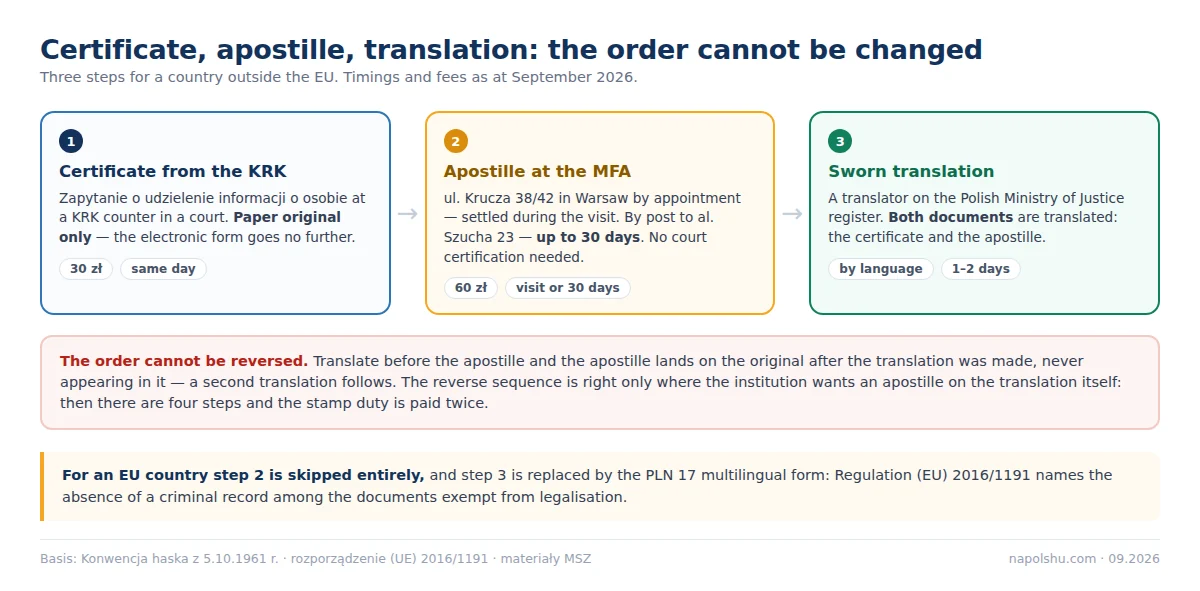
| Sequence | When it is right | What happens if reversed |
|---|---|---|
| Certificate → apostille → translation | the usual case | — |
| Certificate → translation → apostille | only if the translation itself must be apostilled | the apostille on the certificate is untranslated, the pack is incomplete |
| Certificate → apostille → translation → apostille on the translation | the requirement of some consulates | a second PLN 60 stamp duty |
| Translation without an apostille | an EU country | outside the EU the document is refused |
The translation must be made by a sworn translator on the register kept by the Polish Ministry of Justice. A translation made abroad and notarised there is not covered by the Polish apostille, and foreign institutions normally expect a Polish sworn translator, who stamps the document with a register number. The cost depends on the language, which is why we quote this pack only once we know the country and the language.
Name the country and we will price the pack in 15 minutes
Tell us where the document is going and in which language it is expected. We will say whether an apostille is needed at all, whether the PLN 17 form will do instead of a translation, and what the whole pack comes to.
If your record is British: the ACRO certificate
A Polish KRK certificate says nothing about a British record, and a British ACRO Police Certificate says nothing about a Polish one. Anyone who has lived in both countries and is asked to prove a clean record for the whole period needs both, and they are issued by completely separate systems on different terms.
| Point | Poland, KRK | United Kingdom, ACRO |
|---|---|---|
| Issuing body | Krajowy Rejestr Karny | ACRO Criminal Records Office |
| Standard fee | PLN 30 | £55 |
| Faster option | same day at the counter | premium service, £95 |
| Standard timing | same day, or up to 7 days by post | around 12 working days |
| Electronic version | yes, XML through e-KRK | none — paper only |
| Apostille issued by | the Polish MFA, PLN 60 | the FCDO, £45 plus return postage |
| Apostille for Poland | not applicable | required: the UK is outside the EU |
Two things are worth reading twice. First, ACRO issues certificates solely as physical documents — there is no digital certificate and no e-apostille option. The same principle as in Poland, only stricter: in the UK the paperless route does not exist at all.
Second, since Brexit a British certificate presented in Poland is a third-country document: Regulation (EU) 2016/1191 does not cover it, so an FCDO apostille is required, along with a sworn translation into Polish made by a translator on the Polish register. Budget £55 plus £45 plus the translation, and roughly three weeks on the standard service.
If you have lived in several countries
Each certificate covers one country’s register and nothing else. There is no European or international criminal record certificate: a Polish document reports what the Polish register holds, and says nothing about the years you spent elsewhere. Where an institution needs the whole period covered, you collect one certificate per country of residence.
The good news is that the paperwork burden is very uneven, and it depends on whether the issuing country is in the EU.
| Issued in | Apostille for Poland | Translation |
|---|---|---|
| An EU member state | not needed — Regulation (EU) 2016/1191 | multilingual standard form, or a sworn translation |
| Ukraine | not needed — art. 15 of the Poland–Ukraine legal assistance treaty of 24 May 1993 | sworn translation, always |
| The United Kingdom, the United States, Canada, Australia | needed, from that country’s authority | sworn translation into Polish |
| A country outside the Hague Convention | consular legalisation instead | sworn translation into Polish |
The conclusion in one line: a certificate from an EU country or from Ukraine needs no apostille for Poland, everything else does. That single distinction is worth several hundred złoty and two or three weeks per document, so it is the first thing to establish — before paying any foreign authority.
The translation rule has no exceptions worth relying on: the translation must be made by a sworn translator on the Polish Ministry of Justice register. A certified translation obtained in the country of origin will be refused, however well it is stamped there.
How to obtain the certificate: three routes
The certificate is issued three ways: in person at a KRK counter in a court, by post, and electronically through the e-KRK system. A fourth option — through a representative under a power of attorney — formally belongs to the first two, but it is the one that solves the case where you are not in Poland.
KRK information points operate at district and regional courts. The application is called zapytanie o udzielenie informacji o osobie for an individual and zapytanie o udzielenie informacji o podmiocie zbiorowym for a company. The form is completed in Polish and proof of payment is attached.
| Route | Timing | Fee | Suits |
|---|---|---|---|
| In person at a KRK counter | same day, exceptionally up to 7 days | PLN 30 | those in Poland who can attend |
| By post to the KRK | up to 7 days | PLN 30 | those in Poland but far from a court |
| The e-KRK system | up to 20 calendar days | PLN 20 | those with a PESEL and profil zaufany, filing in Poland |
| Through a representative | 1–3 working days | PLN 30 plus PLN 17 stamp duty | those outside Poland or short of time |
The PLN 17 stamp duty on the power of attorney is not charged to close relatives: a spouse, parents, children and siblings. If a relative collects the certificate for you, those 17 złoty drop out of the calculation.
Timings, and why online is the slowest route
The paper certificate is issued on the day of filing, by post within 7 days, and through e-KRK within up to 20 calendar days. This is the only Polish government service we know of where the online channel is slower than the counter, and people are caught by it constantly: they order the “quick” electronic version two weeks before a deadline and miss it.
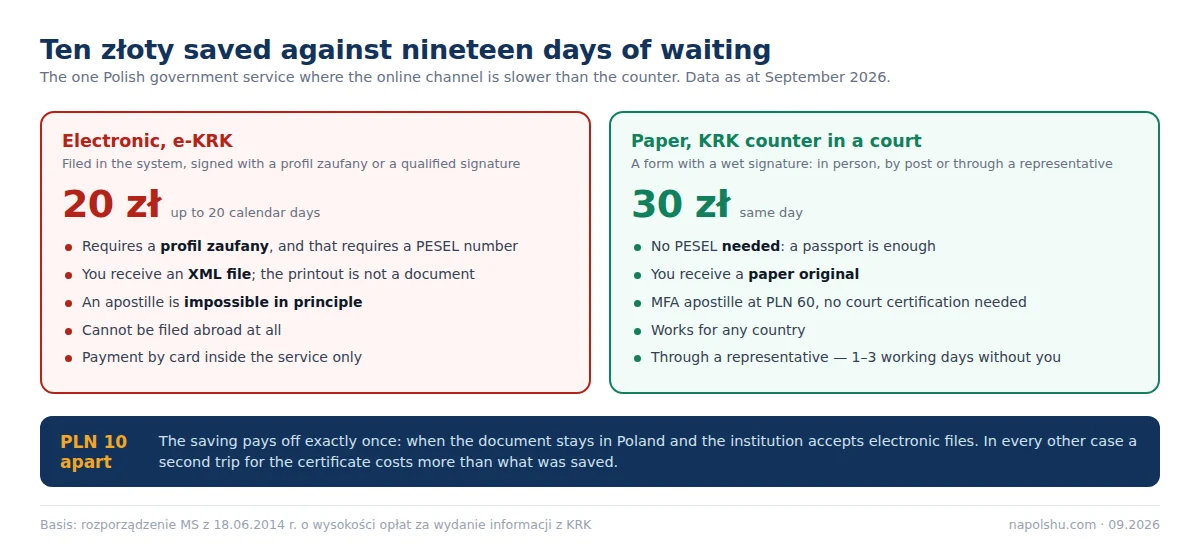
| Step | Fast case | Slow case |
|---|---|---|
| Certificate, paper, in person | same day | up to 7 days |
| Certificate, electronic, e-KRK | a few days | up to 20 calendar days |
| Apostille at the MFA, in person by appointment | during the visit | depends on the appointment |
| Apostille at the MFA, by post | a few days | up to 30 days |
| Sworn translation | 1–2 working days | up to a week for a rare language |
| The whole pack: certificate, apostille, translation | 3–7 working days | up to two months by post |
The conclusion in one line: the difference between the fast and the slow case is not money but the way you file. Both cost the state the same; the postal route simply adds a month at the MFA’s end.
A certificate for a company: when it is needed
A company certificate is a separate document — zapytanie o udzielenie informacji o podmiocie zbiorowym — and it does not replace certificates on board members. It costs the same: PLN 30 on paper, PLN 20 electronically. What it confirms is different: the absence of an entry on the liability of the spółka as a collective entity, not the record of any individual.
Tenders and licensing procedures almost always ask for both sets at once: the company certificate plus one for each member of the zarząd, sometimes for a prokurent as well. For a company with three board members that is four documents and PLN 120 in fees — and, for a foreign tender, four apostilles at PLN 60 each.
| Situation | What is requested | Charges, PLN |
|---|---|---|
| Polish tender, one board member | company certificate and one on the board member | 60 |
| Polish tender, three board members | company certificate and three individual ones | 120 |
| Foreign tender, three board members | the same plus four apostilles | 360 |
| Licence or permit | usually board members only | 30 per person |
| Bank on account opening | usually beneficial owners and the board | 30 per person |
If the certificates are for opening a corporate account, look also at what a bank asks a foreign management board — the document list there is wider than it first appears.
Foreign nationals: what to do without a PESEL
Anyone can obtain a KRK certificate regardless of nationality or whether they hold a PESEL — in paper form. The form takes passport details; the PESEL field is filled in if you have one, and leaving it empty does not block the application. Only the electronic channel is closed, because it needs a profil zaufany, which needs a PESEL.
The second practical point is the spelling of your name. The transliteration on the application must match your passport letter for letter. If the passport says Yevhenii and the application says Evgeniy, the certificate is issued for a different person and has to be redone with a new fee. The same goes for a maiden name: it is entered on a separate line, and without it the register may not find entries under earlier documents.
Third, on certificates from your country of origin. The Polish certificate confirms the absence of a record in the Polish register only and says nothing about the years before you arrived. Employers and authorities that need the whole period covered ask for a second certificate from the country you lived in before — and for work with children that is written into the statute, as set out below.
Working with children: what the Kamilek Act requires
Since 15 February 2024 an employer must verify the record of everyone admitted to work with minors — art. 21 of the ustawa of 13 May 2016 on counteracting the threats of sexual offences and on the protection of minors, known as the Kamilek Act. The check has two parts: a search of the Rejestr Sprawców Przestępstw na Tle Seksualnym and a KRK certificate covering the offences the statute names.
The Act reaches well beyond schools. It covers upbringing, education, recreation, treatment, psychological help, spiritual development, sport and hobby activities — so summer camps, sports clubs, language schools, swimming pools, nannies and tutors engaged through an agency. The employer must place the documents in the employee’s personal file.
A separate rule for anyone who has lived abroad. A candidate who in the last 20 years lived outside Poland must name those countries, attach extracts from their criminal registers and — where a country keeps no such register or issues no certificates — submit a declaration under pain of criminal liability for false statements. For anyone who moved to Poland in recent years this means two documents rather than one.
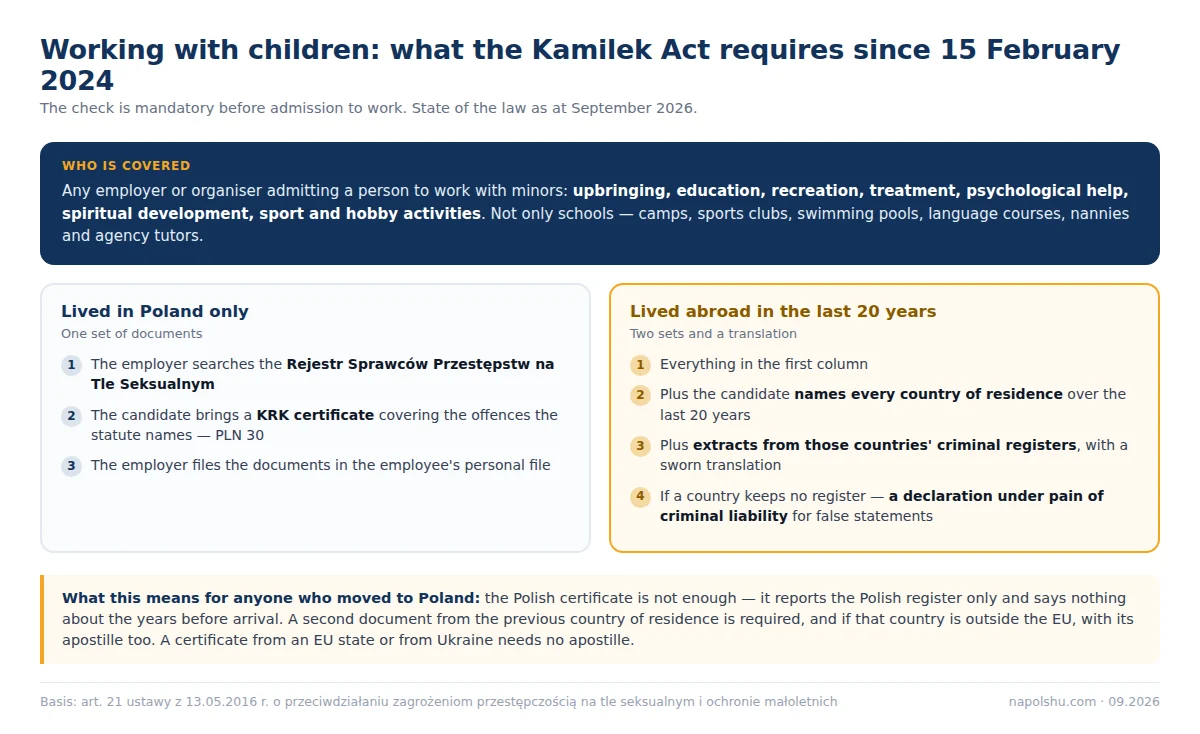
| Candidate | What is required | Charges |
|---|---|---|
| Lived in Poland only | register search and a KRK certificate | PLN 30 |
| Foreign national, three years in Poland | KRK certificate plus a certificate from the previous country, translated | PLN 30 plus the foreign certificate |
| Pole who worked five years abroad | KRK certificate plus one from that country | PLN 30 plus the foreign certificate |
| The country keeps no criminal register | a declaration under pain of criminal liability | 0 |
A foreign certificate almost always needs a sworn translation, and if it comes from outside the EU an apostille from that country as well. It is the mirror image of what we do with the Polish document for use abroad, run in the other direction.
How long the certificate stays valid
No statute sets a validity period at all. The Ministry of Justice confirms it directly: the rules governing the Krajowy Rejestr Karny do not define how long the document remains valid. Neither the Labour Code nor sector statutes introduce such a period either.
In practice the receiving body sets it, and public procurement provides the benchmark: there the certificate must have been issued no earlier than six months before the deadline for submitting tenders. That is where both the three-month and the six-month figures circulating in the market come from — each is one institution’s requirement, not a rule of law.
| Receiving body | Usual requirement |
|---|---|
| Public procurement and tenders | no older than six months at the tender deadline |
| Employer under the Kamilek Act | before admission to work, repeated on new employment |
| Consulates and immigration services | usually three months, sometimes six |
| Banks and licensing authorities | three months |
| Courts in particular procedures | as the court directs |
The conclusion in one line: ask the receiving body about the period before ordering, not after. A certificate obtained “just in case” a year before filing is worth nothing, and redoing a pack with an apostille and a translation costs the full amount again.
Common mistakes
| Mistake | Consequence |
|---|---|
| Ordering the electronic certificate for use abroad | it is refused: only the file has legal force, and the printout is not a document |
| Bringing an e-KRK or ePUAP printout for an apostille | the MFA refuses: the apostille goes on the paper original only |
| Paying for an apostille for an EU country | PLN 60 and a wasted trip: Regulation (EU) 2016/1191 removed the requirement |
| Assuming a British certificate is covered by the EU regulation | since Brexit it is a third-country document and needs an FCDO apostille |
| Waiting for a digital ACRO certificate | there is none: ACRO issues paper only, with no e-apostille option |
| Translating before the apostille | the apostille is not in the translation and a second one is needed |
| Having the translation done abroad | Polish authorities accept only sworn translators on the Ministry of Justice register |
| Transliterating the name differently from the passport | a certificate for a different person and a new fee |
| Choosing e-KRK two weeks before a deadline | issue takes up to 20 calendar days and you miss it |
| Bringing only the Polish certificate for work with children after living abroad | the employer may not admit you: extracts from every country of residence over 20 years are required |
The third row deserves a paragraph of its own. In our practice it is the most pointlessly expensive mistake: someone pays PLN 60 of stamp duty, spends a day travelling to the MFA and carries the document to Spain or the Netherlands, where nobody needs the apostille on it. The check takes a minute — you only have to name the country.
How we work and what it costs
- We start with the destination country. It settles everything else: whether an apostille is needed, whether the PLN 17 form replaces a translation, and in which language the document is expected.
- We check your details before filing. Transliteration against the passport, maiden name, dates, earlier documents — this is where most time is lost when people apply on their own.
- We file the application and pay the fee under a power of attorney, without your involvement; close relatives are exempt from the PLN 17 stamp duty.
- We collect the paper original at a KRK counter in a court.
- We obtain the apostille from the MFA — if one is genuinely needed. We book and file in person so as not to wait the postal 30 days.
- We arrange the sworn translation with a translator on the Polish Ministry of Justice register — of both the certificate and the apostille.
- We deliver the pack by courier within Poland or dispatch it abroad.
| Service | Price | Timing |
|---|---|---|
| Criminal record certificate, paper original | PLN 200 | 1–3 working days |
| Certificate with apostille | PLN 450 | 2–5 working days |
| Certificate with apostille and translation | on request, depends on the language | 3–7 working days |
| State fee for the certificate | PLN 30 | included |
| Stamp duty on the apostille | PLN 60 | included in the pack |
| Certificate on a company (podmiot zbiorowy) | PLN 200 | 1–3 working days |
The price is fixed before the work starts and does not change during it, and we take no advance payment. If your answers show that no apostille is needed, we say so before you pay and issue the certificate for PLN 200 instead of the PLN 450 pack.
Fifteen minutes to assemble the right pack
Name the country and the institution you are filing with. We will tell you which form of certificate you need, whether an apostille is required, what can replace a translation and how long it will take.
Further reading
- The PESEL number for foreigners — without it the e-KRK channel is closed
- A bank account for a Polish company — what banks ask a foreign management board
- Changes in the KRS — board changes and who ends up on the company certificates
- The EORI number — the customs identifier for a Polish company
- The MIP payment licence — a procedure requiring certificates on every board member
- Price list — every service and what it costs
Frequently asked questions
How much does a Polish criminal record certificate cost?
The state fee is PLN 30 for a paper certificate and PLN 20 for an electronic one through the e-KRK system. An apostille adds PLN 60 of stamp duty per document. Turnkey support from napolshu.com/ is PLN 200 for the certificate and PLN 450 for the certificate with an apostille, state charges included.
Can I order the certificate online?
Yes, through e-KRK, if you hold a profil zaufany or a qualified EU signature. But the document arrives as an XML file and its printout has no legal force: such a certificate can only be filed with a Polish institution electronically. Issue takes up to 20 calendar days.
Can an apostille be placed on the electronic certificate?
No. The Ministry of Foreign Affairs states expressly that no apostille is placed on a photocopy of a document or on a printout from the ePUAP platform. Only the paper original issued at a Krajowy Rejestr Karny counter can be apostilled. If the document is going abroad, order the paper form from the outset.
Do I need an apostille if the document is filed in an EU country?
No. Regulation (EU) 2016/1191 abolished the apostille and legalisation requirement between Union countries, and “the absence of a criminal record” is named in it expressly. An institution in another EU country must accept the Polish certificate without one; a PLN 17 multilingual form can replace the translation.
Does a British ACRO certificate need an apostille for Poland?
Yes. Since Brexit a UK document is a third-country document and falls outside Regulation (EU) 2016/1191, so an FCDO apostille is required at £45, plus a sworn translation into Polish. ACRO itself charges £55 standard or £95 premium and issues paper certificates only — there is no digital version.
How do I get the Polish certificate with an apostille if I am not in Poland?
Through a power of attorney. A representative files the application at a KRK counter, collects the paper original and submits it to the MFA for the apostille. Stamp duty on the power of attorney is PLN 17, and close relatives are exempt. The finished pack is couriered to any address.
How long does the certificate stay valid?
No statute sets a period: the Ministry of Justice confirms that the rules on the Krajowy Rejestr Karny do not define validity. In practice the receiving body decides. In public procurement the certificate must be issued no earlier than six months before the tender deadline; consulates more often ask for no older than three months.
Do I need a PESEL number to obtain the certificate?
Not for the paper certificate: the form takes passport details and the PESEL field stays empty if you have no number. A PESEL is needed only for the electronic channel, because that requires a profil zaufany. A foreign national without a PESEL applies in person or through a representative.
Which certificates are required to work with children in Poland?
Since 15 February 2024 the employer must search the Rejestr Sprawców Przestępstw na Tle Seksualnym and obtain a KRK certificate — art. 21 of the ustawa on counteracting the threats of sexual offences and on the protection of minors. Anyone who lived abroad in the last 20 years also brings extracts from those countries’ registers.
This page is for information only and does not replace individual legal advice. Rates, deadlines and charges are stated as at September 2026.
Author: Marta Kowalik, lawyer at napolshu.com/. Verified on 15 September 2026. Sources: the ustawa of 24 May 2000 on the Krajowy Rejestr Karny; the rozporządzenie of the Minister of Justice of 18 June 2014 on the fees for information from the KRK; art. 21 of the ustawa of 13 May 2016 on counteracting the threats of sexual offences and on the protection of minors; Regulation (EU) 2016/1191 of the European Parliament and of the Council; the Hague Convention of 5 October 1961; art. 15 of the Poland–Ukraine treaty on legal assistance of 24 May 1993 (Dz. U. 1994 No. 96, item 465); gov.pl, Krajowy Rejestr Karny and Ministry of Foreign Affairs materials; ACRO and FCDO published fees.
