
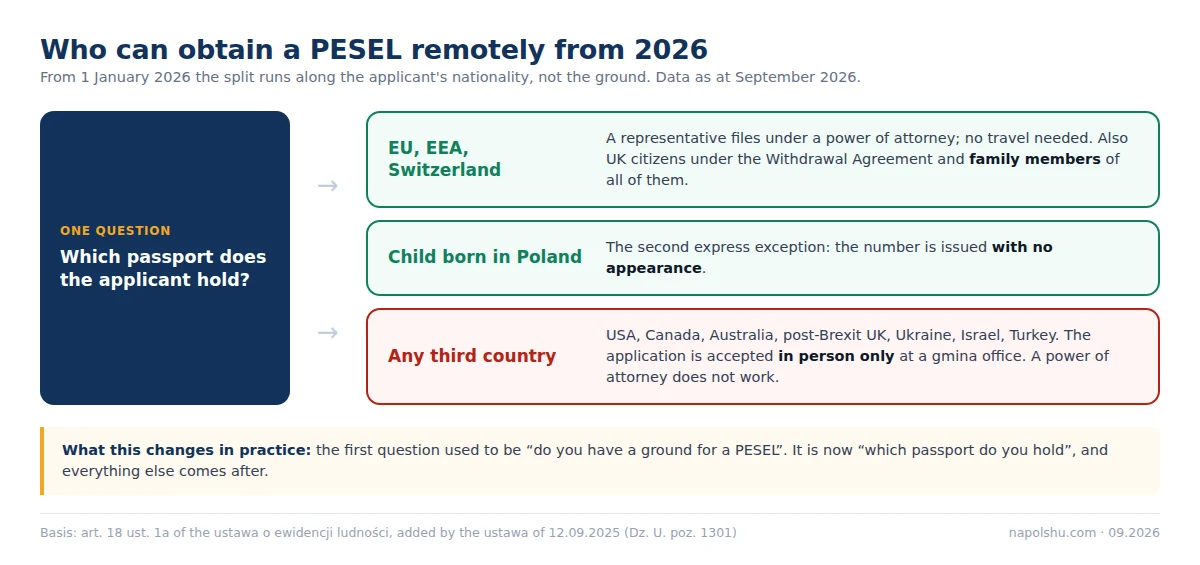
Since 1 January 2026 not every foreigner can obtain a PESEL number remotely. Personal appearance at the gmina office is mandatory for third-country nationals — art. 18 ust. 1a of the ustawa o ewidencji ludności, added by the ustawa of 12 September 2025 (Dz. U. poz. 1301). The exemption is kept for nationals of the EU, the EEA and Switzerland, UK citizens who are beneficiaries of the Withdrawal Agreement, their family members, and children born in Poland. The number itself is issued free of charge.
Six months ago this page would have read differently. Until 2026 a foreign founder could obtain a PESEL without setting foot in Poland: a notarised power of attorney, a representative at the gmina, the number within days. Half the remote company-formation market was built on that, and — judging by the search results — is still being sold on it.
The rule changed; the copy did not. Check the last-updated date on anyone still promising you a PESEL by proxy without travel. For a US, Ukrainian, Israeli, Turkish or post-Brexit British national that promise cannot be kept in 2026: the gmina is required to see the applicant in person.
In brief
- From 1 January 2026 a third-country national files the PESEL application in person — art. 18 ust. 1a of the ustawa o ewidencji ludności. A power of attorney no longer works for them.
- EU, EEA and Swiss nationals, UK citizens under the Withdrawal Agreement and their family members are unaffected. The remote route stays open to them exactly as before.
- A British passport is no longer enough on its own. Only Withdrawal Agreement beneficiaries keep the exemption; a UK national who first came to Poland after the transition period is a third-country national.
- Children born in Poland receive the number without any appearance — the second express exception in the provision.
- The number is free. The only payment is PLN 17 of stamp duty on a power of attorney, where one still applies.
- The application must cite a legal basis (art. 18 ust. 2) — a specific provision obliging you to hold a PESEL. Without it the application is not examined on the merits.
What changed on 1 January 2026
The ustawa of 12 September 2025 amending certain acts (Dz. U. poz. 1301) inserted a new art. 18 ust. 1a into the ustawa o ewidencji ludności. It requires the applicant to appear in person before the gmina authority when filing an application for a PESEL number. The provision has applied since 1 January 2026.
The requirement is targeted. It does not reach nationals of EU member states, EEA states or Switzerland, UK citizens who are beneficiaries of the Withdrawal Agreement, or the family members of any of those. For these groups a representative may still file under a power of attorney exactly as before.
Outdated information in search results. A large share of English-language pages on obtaining a PESEL remotely, commercial offers included, still describes the pre-2026 process: “power of attorney, a representative, no need to travel”. For a third-country national that no longer works. The rule is art. 18 ust. 1a of the ustawa o ewidencji ludności and it took effect on 1 January 2026. Municipal information pages have not all been updated either.
The stated reason for the change is straightforward: remote issue of the number was being used to set up shell companies in the names of nominees. The side effect falls on legitimate founders, and it has to be planned around.
| Applicant | Before 01.01.2026 | From 01.01.2026 |
|---|---|---|
| EU, EEA or Swiss national | by proxy | by proxy |
| Third-country national | by proxy | in person only |
| Child born in Poland | no appearance | no appearance |
| Legal basis for the requirement | — | art. 18 ust. 1a of the ustawa o ewidencji ludności |
| Cost of issuing the number | PLN 0 | PLN 0 |
In one line: the applicant’s nationality now matters more than the ground for the number. The first question used to be “do you have a basis for a PESEL”; it is now “which passport do you hold”.
Who can still apply remotely
| Applicant | Remote, by proxy | Provision |
|---|---|---|
| National of an EU member state | Yes | exception in art. 18 ust. 1a |
| National of an EEA state or Switzerland | Yes | same exception |
| UK citizen, Withdrawal Agreement beneficiary | Yes | same exception |
| Family member of any of the above | Yes | same exception |
| Child born in Poland | Yes | express exception in the provision |
| US, Canadian, Australian national | No | personal appearance under art. 18 ust. 1a |
| UK citizen outside the Withdrawal Agreement | No | personal appearance under art. 18 ust. 1a |
| Ukrainian, Georgian, Turkish, Israeli national | No | personal appearance under art. 18 ust. 1a |
One line worth remembering: being the family member of an EU national is itself enough to keep the remote route open, whatever your own nationality. If your spouse holds an EU passport, check this before you book flights.
UK citizens: the Withdrawal Agreement line
This is the distinction that catches British clients out, and it is worth stating plainly. A UK passport does not by itself keep the remote route open. The exemption covers UK citizens who are beneficiaries of the Withdrawal Agreement — broadly, those who were exercising free-movement rights in Poland before the end of the transition period and hold the residence status that follows from it.
A British founder who first came to Poland in 2023 to set up a company is, for these purposes, in the same position as an American or an Australian: a third-country national who must appear in person. The passport looks identical; the legal position is not.
| Situation | Remote filing | Why |
|---|---|---|
| Lived in Poland before the end of the transition period, holds the resulting status | Yes | Withdrawal Agreement beneficiary |
| Family member of such a person | Yes | covered by the same exception |
| Arrived after the transition period | No | third-country national |
| Never resided in Poland, forming a company remotely | No | third-country national |
| Holds an EU passport as well as a British one | Yes | the EU nationality decides |
Practical consequence: dual nationality is worth checking before anything else. An Irish, Polish or other EU passport in the family removes the problem entirely.
Who needs a PESEL and what for
PESEL is the individual identification number held in the Polish population register. Both Polish citizens and foreigners have one; it is how the tax office, the social security institution, banks, courts and registers identify a person.
| Task | What the PESEL gives you | Possible without it |
|---|---|---|
| Profil zaufany | the profile cannot be created without one | yes, via an EU qualified signature |
| Company registration in S24 | signing with the profil zaufany | yes, with a qualified signature |
| KRS changes through PRS | the same | yes, with a qualified signature |
| Opening a Polish bank account | the bank identifies the director faster | sometimes, but slower and not everywhere |
| Filings and the CRBR | the number appears in the person’s data | partly, depending on the register |
| e-Urząd Skarbowy and PUE ZUS | login via the profil zaufany | yes, with a qualified signature |
| Personal matters: doctor, school, gmina | the primary identifier | no |
The conclusion that saves money: if you only want the number in order to sign things, you may not need it at all. A qualified electronic signature from any provider on the EU trusted list works directly in S24, PRS and PUESC and requires no PESEL.
Three routes to the number
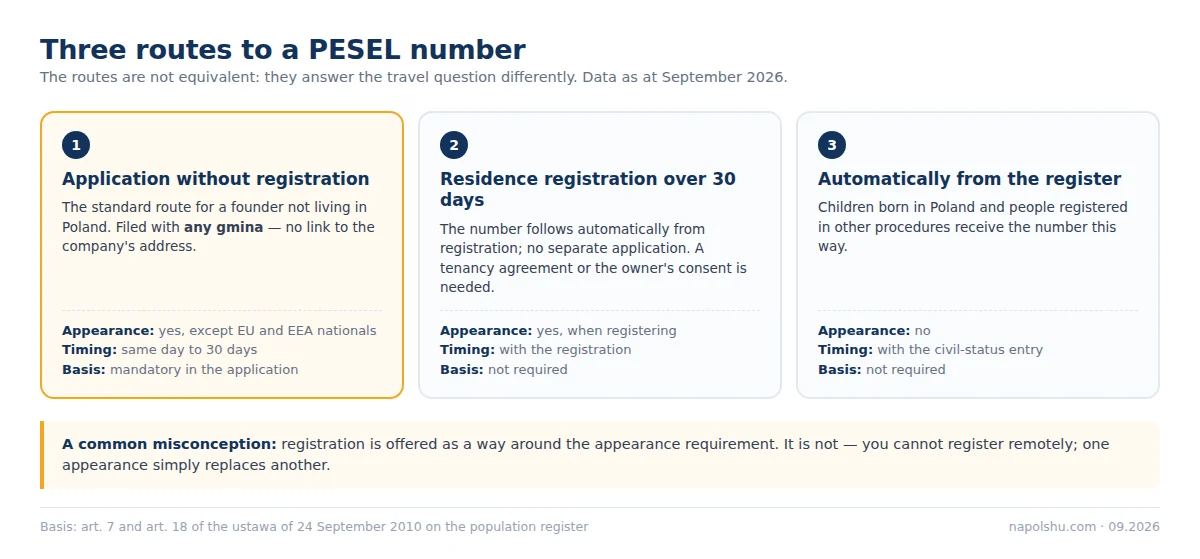
- Application without residence registration. The standard route for a founder who does not live in Poland. It is filed with any gmina — there is no link to the company’s address. This is where the 2026 personal-appearance requirement bites.
- Residence registration for more than 30 days. Register your residence and the number is issued automatically, with no separate application. You will need a tenancy agreement or the owner’s consent.
- Automatically from the register. Children born in Poland and people registered in other procedures receive the number this way.
| Route | Who it suits | Appearance required | Timing |
|---|---|---|---|
| Application without registration | founders, board members, signatories | yes, except EU and EEA nationals | same day to 30 days |
| Residence registration over 30 days | people actually living in Poland | yes, when registering | with the registration |
| Automatically from the register | children born in Poland | no | with the civil-status entry |
Residence registration does not get around the appearance requirement, it replaces one appearance with another. You cannot register a residence remotely, and this is frequently offered as a loophole. There is none.
The legal basis: applications fail without it
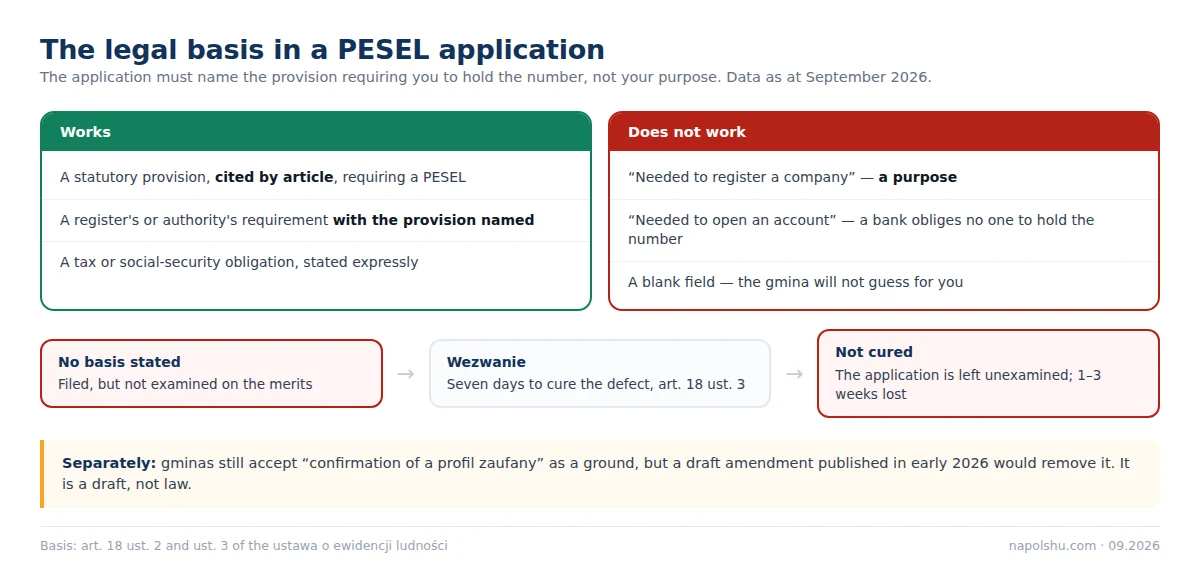
This is where self-filed applications most often come apart. The application must state a legal basis — art. 18 ust. 2 of the ustawa o ewidencji ludności says so expressly. The basis is a specific provision of another statute that obliges you to hold a PESEL number.
“I need it for my business” or “the bank asked for it” is not a legal basis. The gmina is not required to work out which provision you had in mind: it will issue a notice to cure the defect within seven days (art. 18 ust. 3) and then leave the application unexamined.
| Wording | Works | Why |
|---|---|---|
| A statutory provision, cited by article, requiring a PESEL | Yes | this is what art. 18 ust. 2 asks for |
| A register’s or authority’s requirement, with the provision named | Yes | the provision is named |
| “Needed to register a company” | No | a purpose, not a legal basis |
| “Needed to open a bank account” | No | a bank does not oblige anyone to hold the number |
| “Needed for the profil zaufany” | For now yes, but see below | a draft amendment would remove it |
| Nothing stated | No | seven-day notice, then refusal |
Documents and the power of attorney
The application is filed on paper, with a handwritten signature — a direct requirement of art. 18 ust. 1. There is no electronic form for this procedure.
| Document | Required | Comment |
|---|---|---|
| Paper application, signed by hand | Yes | art. 18 ust. 1, no electronic filing |
| Valid travel document | Yes | shown in the original |
| The legal provision cited in the application | Yes | art. 18 ust. 2 |
| Birth or marriage certificate | Sometimes | where the passport does not evidence the data |
| Sworn translation into Polish | Yes, for non-Polish documents | by a translator on the Ministry of Justice list |
| Power of attorney | EU and EEA nationals only | no longer available to third-country nationals |
| Stamp duty on the power of attorney | PLN 17 | where a power of attorney still applies |
On legalisation: EU membership does not by itself exempt foreign documents from an apostille. The EU regulation that removed legalisation covers civil-status records, not commercial or corporate documents, and the answer depends on the issuing country. A sworn translation, by contrast, is required in every case.
Timing and cost
Issuing a PESEL number is free. The state charges nothing for it — no fee, no paid fast track. The only compulsory payment arises where a power of attorney is used: PLN 17 of stamp duty per instrument.
The deadline follows the general rule of administrative procedure: the matter is dealt with without undue delay and no later than 30 days from filing. In practice, with a complete file and a properly cited basis, the number is issued on the day of the visit or within a few working days.
| Situation | What the rule says | In practice |
|---|---|---|
| Complete file, basis cited | without undue delay, up to 30 days | same day or 1–3 days |
| Remote filing for an EU national | the same | 1–7 business days |
| No basis stated | seven-day notice to cure | add 1–3 weeks |
| Additional verification of data needed | up to 30 days | up to a month |
| Issue through residence registration | with the registration | same day |
A planning rule follows: allow two weeks before the date you actually need the number. If the PESEL is meant to sign incorporation documents and you start three days before signing, you are already late.
We will check your basis before filing
We will tell you whether the remote route is open to you, which provision to cite, and what to do if the number is out of reach. For EU nationals we handle it without any travel.
What the gmina visit looks like
- The application is prepared in advance. Basis, data, the transliteration of your name exactly as in the passport — all of it done before the trip, not in the queue.
- Any gmina will do. There is no link to the company’s address, and it is worth using: queues in smaller offices are far shorter than in central Warsaw.
- The appointment takes minutes. The clerk accepts the application, checks the passport and, if the basis holds, issues the number on the spot.
- The profil zaufany is set up on the same trip, if you need one: the number already exists, only identity confirmation is left.
- Banking is closed out at the same time, since most banks want the director present anyway.
| Task | Personal appearance | How long |
|---|---|---|
| PESEL application | yes, for third-country nationals | minutes at the counter |
| Confirming the profil zaufany | yes, unless you hold a Polish bank account | 15–30 minutes |
| Opening a bank account | yes, in most banks | an hour upwards |
| Notarial company documents | yes | by appointment |
| Obtaining a qualified signature | no | done in advance, remotely |
Running a Polish company without a PESEL
The common scenario: the founder is a third-country national, cannot travel for months, and the company has to be registered or amended now. The PESEL is out of reach in that scenario, but the underlying task is not.
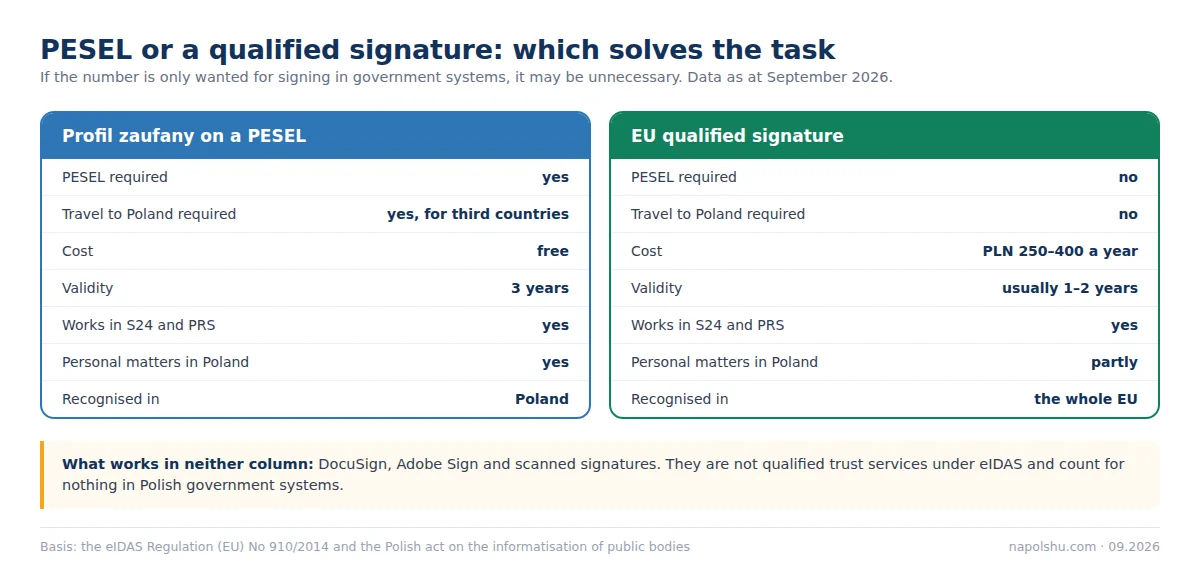
A qualified electronic signature from any provider on the EU trusted list requires no PESEL. It works in S24, in the Portal Rejestrów Sądowych and in PUESC directly under the eIDAS Regulation. Your own nationality is irrelevant — what matters is the country of the trust service provider.
DocuSign and Adobe Sign are not qualified trust services in the eIDAS sense. They produce a perfectly enforceable commercial signature and count for nothing in a Polish government system. The same applies to a scanned wet signature and to non-EU national e-signature schemes.
| Feature | Profil zaufany | EU qualified signature |
|---|---|---|
| PESEL required | yes | no |
| Travel to Poland required | yes, for third-country nationals | no |
| Cost | free | PLN 250–400 a year |
| Validity | 3 years | usually 1–2 years |
| Recognised in | Polish government systems | the whole EU |
| Works in S24 and PRS | yes | yes |
| Personal matters in Poland | yes | partly |
Two further options are worth knowing. A notarised power of attorney to a representative in Poland covers most corporate acts, and appointing at least one EU-resident board member removes the recurring problem entirely for companies that will file often.
Profil zaufany: what it opens
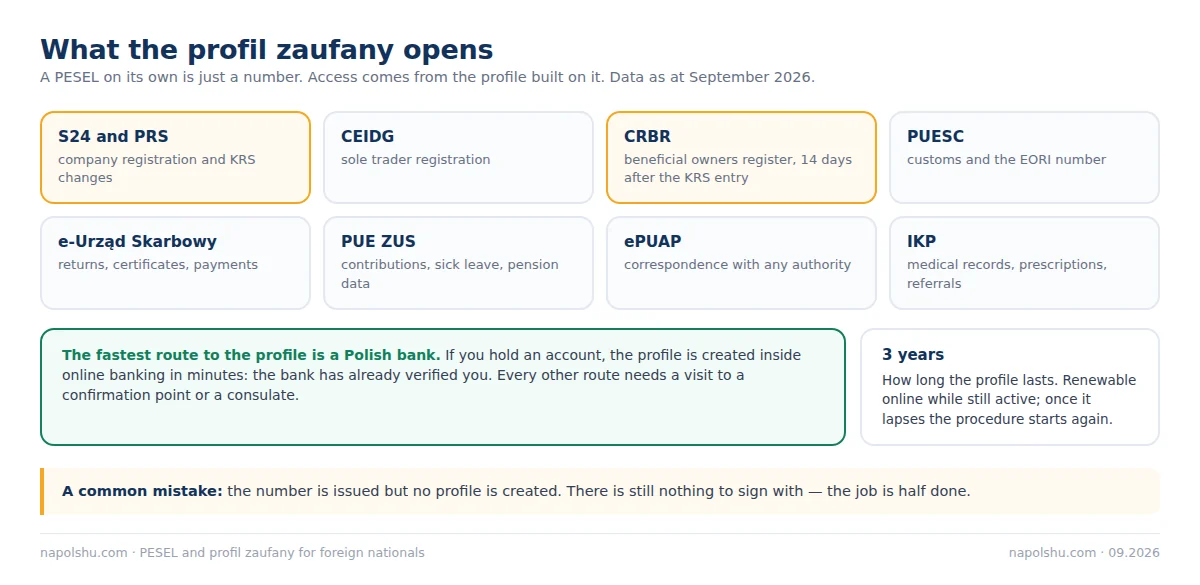
The profil zaufany is a free means of confirming identity in Polish government systems. It replaces a handwritten signature in dealings with the state and is valid for three years, renewable online while still active.
| System | Used for |
|---|---|
| S24 and the Portal Rejestrów Sądowych | company registration and KRS changes |
| CEIDG | sole trader registration |
| CRBR | beneficial owners register, 14 days after the KRS entry |
| PUESC | customs and the EORI number |
| e-Urząd Skarbowy | returns, certificates, payments |
| PUE ZUS | contributions, sick leave, pension data |
| ePUAP | correspondence with any authority |
| IKP | medical records, prescriptions, referrals |
The fastest route to the profile is a Polish bank: if you hold an account, the profile is created inside online banking in minutes, because the bank has already verified your identity. Every other confirmation route needs a visit to a confirmation point or a consulate.
What is coming next
Worth knowing in advance, because it changes planning. In early 2026 a draft amendment was published on the website of the Rządowe Centrum Legislacji which would expressly remove confirmation of a profil zaufany from the list of grounds for issuing a PESEL number.
Status as at 9 September 2026: a draft, not law. No commencement date has been fixed; the draft provides for the main changes to take effect two weeks after publication in the Journal of Laws. For now, gminas still accept that ground.
Practically: if the profil zaufany is your only ground, do not put the application off. And check at the same time whether you have a firmer one — anyone actually running a business in Poland usually does.
Common mistakes when filing yourself
| Mistake | Consequence |
|---|---|
| Relying on a power of attorney as a third-country national | the application is refused and the trip is needed anyway |
| Assuming a British passport still qualifies | only Withdrawal Agreement beneficiaries are exempt |
| No legal basis stated in the application | seven-day notice, then refusal |
| A purpose given instead of a provision | the same |
| Filing electronically | no electronic form exists: paper and a wet signature |
| Documents without a sworn translation | the application is not examined on the merits |
| Name transliterated differently from the passport | the number attaches to the wrong spelling and mismatches follow in every register |
| PESEL obtained but no profil zaufany created | still nothing to sign documents with |
| Starting days before a signing date | the statutory deadline is up to 30 days and cannot be shortened |
The last row deserves a sentence of its own. There is no paid express procedure for a PESEL number. The only things you can influence are the completeness of the file and the correctness of the basis — and those turn a thirty-day deadline into a single visit.
How we work and what it costs
- We start with the passport. Nationality decides whether the remote route exists at all — that is the first and the decisive question.
- We identify the legal basis. Not a purpose but a provision: something the gmina will accept without a notice to cure.
- We prepare the application and the document pack, and arrange sworn translations where needed.
- For EU nationals we file under a power of attorney and run the case to issue. For third-country nationals we book the gmina appointment and attend with you.
- We create the profil zaufany against the new number and confirm that it actually signs documents.
- We hand over the certificate and explain where the number will be needed next: KRS, CRBR, the bank, filings.
| Service | Price | Timing |
|---|---|---|
| PESEL remotely, EU, EEA and Swiss nationals | from PLN 650 | 1–7 business days |
| PESEL and profil zaufany | PLN 800 | 1–7 business days plus confirmation |
| Visit support for third-country nationals | on request | one visit to a gmina |
| Issue of the number by the state | PLN 0 | without undue delay, up to 30 days |
| Stamp duty on the power of attorney | PLN 17 | included |
Fifteen minutes to map your situation
We will tell you whether remote filing is open to you, which provision to cite, and whether you need a PESEL at all — a qualified signature often solves the same problem.
Further reading
- The PESEL number explained — the procedure in detail
- Signing Polish filings from abroad — which e-signatures actually work
- Changes in the KRS — where a PESEL is needed and where a signature suffices
- EORI number — the customs identifier, no PESEL required
- A bank account for your Polish company — what banks ask a foreign director
- Company registration in Poland — how to arrange everything in one trip
Frequently asked questions
Can I still get a PESEL number remotely in 2026?
Only if you are a national of an EU or EEA state or Switzerland, a UK citizen who is a beneficiary of the Withdrawal Agreement, or a family member of one of those. Since 1 January 2026 every other foreign national must file the application in person at a gmina office — art. 18 ust. 1a of the ustawa o ewidencji ludności.
Does a British passport still allow remote filing?
Not on its own. The exemption covers UK citizens who are beneficiaries of the Withdrawal Agreement — broadly those who were exercising free-movement rights in Poland before the end of the transition period. A British national who first came to Poland after that is treated as a third-country national and must appear in person.
How much does a PESEL number cost?
The number is issued free of charge; the state takes no fee. The only compulsory payment arises where a power of attorney is used: PLN 17 of stamp duty. The napolshu.com/ service starts at PLN 650 for EU nationals, stamp duty included.
How long does it take?
Under the general rule of administrative procedure the matter is dealt with without undue delay and no later than 30 days from filing. In practice, with a complete file and a properly cited legal basis, the number is issued on the day of the visit or within a few working days. There is no paid express procedure.
What do I write under “legal basis” in the application?
A specific statutory provision that obliges you to hold a PESEL number — art. 18 ust. 2 of the ustawa o ewidencji ludności requires it. A purpose such as “needed to register a company” is not a basis: the gmina will issue a seven-day notice to cure the defect and then leave the application unexamined.
Can I register a Polish company without a PESEL?
Yes. A qualified electronic signature issued by a provider on the EU trusted list works directly in S24 and in the Portal Rejestrów Sądowych under the eIDAS Regulation and requires no PESEL. The second route is a notarised power of attorney to a representative in Poland. If you want the number only in order to sign, it may be unnecessary.
Will DocuSign work for Polish filings?
No. DocuSign and Adobe Sign are not qualified trust services under eIDAS and carry no weight in Polish government systems, and neither does a scanned signature. You need a profil zaufany, which requires a PESEL, or a qualified signature from an EU provider.
Does registering my residence avoid the personal appearance?
No. Registering a residence for more than 30 days does mean the number is issued automatically, without a separate application, but residence registration cannot be done remotely. One appearance is simply replaced by another.
How long is a profil zaufany valid?
Three years, renewable online while still active; after it lapses the procedure has to be repeated. The quickest way to create and confirm one is through the online banking of a Polish bank where you hold an account, because the bank has already verified you.
This page is for information only and does not replace individual legal advice. Rules, deadlines and charges are stated as at September 2026.
Author: Marta Kowalik, lawyer at napolshu.com/. Verified on 9 September 2026. Sources: ustawa of 24 September 2010 on the population register, ustawa of 12 September 2025 amending certain acts (Dz. U. poz. 1301), the Polish Stamp Duty Act, gov.pl materials and municipal information pages.
