
An apostille in Poland costs PLN 60 of stamp duty per document, and the Ministry of Foreign Affairs issues most of them during the visit itself. But the MFA is not the only authority: a Polish university diploma goes to NAWA instead, where the statutory term is 60 days. Which authority your document belongs to decides the cost, the timing and whether an express service is possible at all. Figures as at November 2026.
The second thing that catches people out has nothing to do with the apostille itself. Polish authorities return documents by registered post only to addresses in Poland, the EU, Iceland, Liechtenstein, Norway and Switzerland. If you live in the United Kingdom, the United States, Canada, Australia or anywhere else, they will not post it to you — you have to name a representative with a Polish address.
Below: what the state actually charges, how to tell which authority your document goes to, the certifications some documents need before the apostille, when you need no apostille at all, and how to get the paper into your hands if you are not in Europe.
In brief
- The stamp duty is PLN 60 per document, paid to the tax office account before filing. The MFA charges nothing else.
- The MFA apostilles most documents during the visit, by appointment through the e-Konsulat system, up to ten documents per person per day. By post it is up to 30 days.
- University diplomas do not go to the MFA at all. Since 1 February 2018 they go to NAWA, the National Agency for Academic Exchange, with a statutory term of 60 days.
- Notarial and court documents need prior certification by a sąd okręgowy, commercial documents by the Krajowa Izba Gospodarcza. Invoices and customs papers are not apostilled at all.
- Poland has no e-Apostille. It is a printed sticker with a hologram, a wet signature and a seal, placed on the original — never on a copy, a scan or an ePUAP printout.
- Between EU countries no apostille is required for civil status records and criminal record certificates — Regulation (EU) 2016/1191.
- What an apostille costs in Poland in 2026
- Which authority issues your apostille — and it is not always the MFA
- Polish university diplomas go to NAWA
- Documents that must be certified before the apostille
- When you need no apostille at all
- Getting the paper back if you live outside Europe
- How the procedure runs, step by step
- How long it takes
- Why there is no e-Apostille in Poland
- Bringing a foreign document into Poland
- Sworn translation: when, in what order, by whom
- Apostille or consular legalisation
- Why applications come back unprocessed
- How we work and what it costs
- What these Polish names mean
What an apostille costs in Poland in 2026
The state charges PLN 60 of stamp duty for each document apostilled by the Ministry of Foreign Affairs. That is the whole charge at the MFA: there is no separate filing fee, no express surcharge and no per-page rate. What varies is everything around it — prior certification, translation, and getting the paper to you.
| Charge | Amount, PLN | Paid to |
|---|---|---|
| Apostille, per document | 60 | stamp duty, to the tax office account |
| Consular legalisation, per document | 26 plus the embassy's own fee | MFA and the receiving country's embassy |
| Prior certification at a sąd okręgowy | usually 20–100 | the court, at its own tariff |
| Prior certification by a chamber of commerce | at the chamber's tariff | Krajowa Izba Gospodarcza or a regional chamber |
| Apostille on a university diploma | set per document by NAWA | NAWA, to its own account |
| Sworn translation | 45–60 per page | a translator on the Ministry of Justice register |
One honest note on the NAWA line. NAWA does not publish the amount as text on its own site — the figure appears only inside an image on its payment page, and the instruction is to pay "an amount matching the number of documents submitted". We confirm the current figure with NAWA before filing rather than quote it from a third party; so should anyone else who tells you a number.
Doing it yourself, one apostilled document costs PLN 60 and two or three trips across Warsaw. That is the honest comparison: the money is small, the time is not, and the risk is that the document comes back unprocessed for a reason listed further down this page.
Which authority issues your apostille — and it is not always the MFA
This is the decision that governs everything else on this page. Poland splits apostille competence across several bodies by document type, and filing with the wrong one does not get you redirected — it gets the papers posted back, and you start again. The Ministry of Foreign Affairs handles the largest share, but not diplomas, not school certificates and not art-school documents.
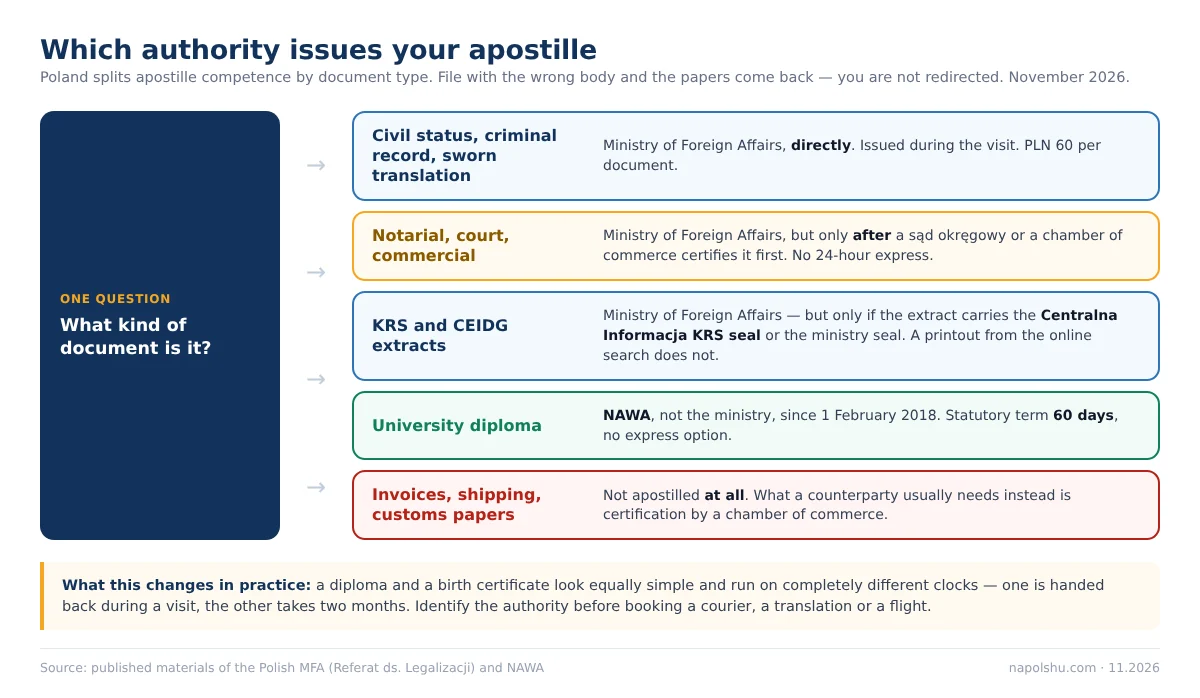
| Document | Authority | Prior certification |
|---|---|---|
| Civil status records: birth, marriage, death | Ministry of Foreign Affairs | none, if it carries the USC seal and a named stamp |
| Criminal record certificate from the KRK | Ministry of Foreign Affairs | none |
| Sworn translations | Ministry of Foreign Affairs | none |
| KRS extract | Ministry of Foreign Affairs | must bear the seal and signature of Centralna Informacja KRS |
| CEIDG extract | Ministry of Foreign Affairs | must bear the ministry seal and an official's signature |
| Notarial deeds and powers of attorney | Ministry of Foreign Affairs | yes — the sąd okręgowy first |
| Court documents | Ministry of Foreign Affairs | yes — the president of the sąd okręgowy |
| Commercial documents | Ministry of Foreign Affairs | yes — Krajowa Izba Gospodarcza |
| University diplomas and supplements | NAWA | none, but a 60-day term |
| School certificates, matura | the ministry of education, the kurator oświaty or the examination board | depends on the document |
| Art-school documents | Ministry of Culture and National Heritage | — |
| Medical specialist diplomas, LEK and LDEK | Ministry of Foreign Affairs | yes — the Ministry of Health |
| Master-craftsman diplomas | Ministry of Foreign Affairs | yes — Związek Rzemiosła Polskiego |
| Invoices, shipping and customs papers | none | not apostilled at all |
The conclusion in one line: identify the authority before you buy a flight, a courier or a translation. A diploma and a birth certificate look equally simple and run on completely different clocks — one is handed back during a visit, the other takes two months.
Polish university diplomas go to NAWA
If you graduated from a Polish university, your diploma is apostilled by NAWA — the Narodowa Agencja Wymiany Akademickiej — and not by the Ministry of Foreign Affairs. Competence moved from the ministries to NAWA on 1 February 2018, and it covers documents issued by Polish higher-education institutions. A diploma from any other country can only be certified in the country that issued it.
This matters most to the people least likely to know it: graduates of Poland's English-language programmes — medicine, dentistry, engineering, business — who need the diploma recognised in the United States, the United Kingdom, Canada, India or Nigeria, and who have usually left Poland by the time they need it.
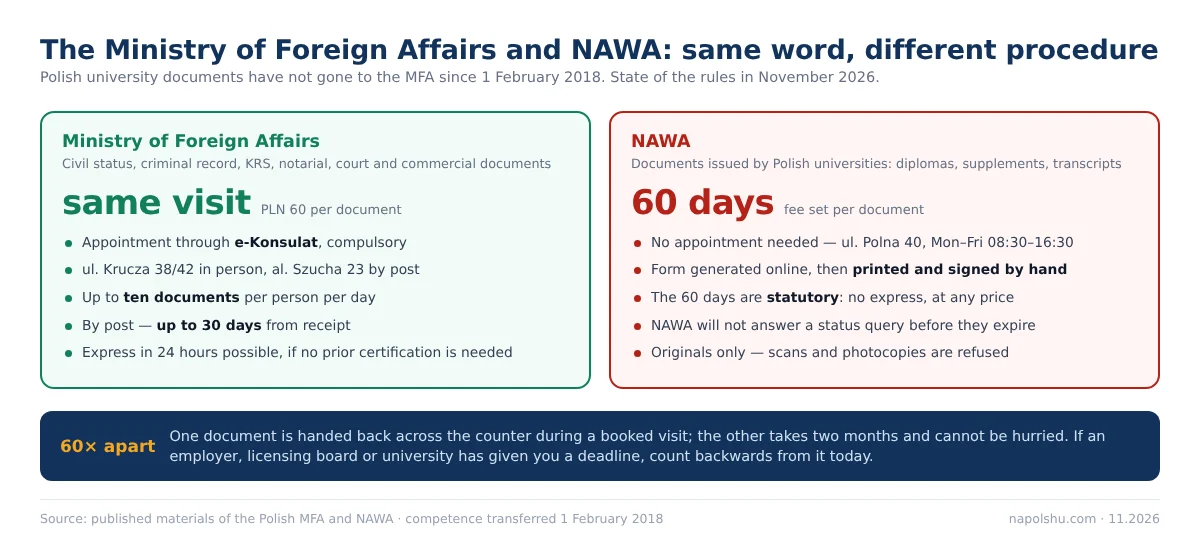
| Point | Ministry of Foreign Affairs | NAWA |
|---|---|---|
| What it apostilles | civil status, criminal record, KRS, notarial, court, commercial documents | documents issued by Polish universities |
| Charge | PLN 60 per document | set per document; not published as text on NAWA's site |
| Processing | during the visit, by appointment; up to 30 days by post | 60 days from registration of a complete set |
| Appointment | compulsory, through e-Konsulat | none needed; office hours Mon–Fri 08:30–16:30 |
| Where | ul. Krucza 38/42 in person, al. Szucha 23 by post | ul. Polna 40, 00-635 Warszawa |
| Application | paper form with the fee confirmation | generated at the online portal, then printed and signed by hand in blue ink |
| Express possible | yes, if no prior certification is needed | no — the 60 days are statutory |
Three details that decide whether your file is accepted. Originals only — NAWA states plainly that scans and photocopies are not accepted, and an emailed application is not a filing. The form is generated online but delivered on paper, printed, dated and signed by hand. And NAWA does not answer status questions before the 60 days have run, so there is nothing to chase in the meantime.
A few document types have their own rules. A transcript of studies is accepted only in two situations: studies completed before 2005, when diploma supplements did not yet exist, and studies interrupted or never finished. A certificate of admission to studies is not certified at all, and neither are internship or placement certificates — those go to the body that supervises the profession.
If your document was certified before 2018, it still stands. An authentication by the former ministry of science followed by legalisation at the MFA, done correctly before the transfer of competence, does not have to be repeated at NAWA. An apostille has no expiry date, and neither does a legalisation — what expires is the patience of the institution asking for a recent one.
Documents that must be certified before the apostille
The Ministry of Foreign Affairs apostilles some documents directly and others only after a second authority has certified them first. The reason is mundane: the ministry holds specimen seals and signatures for some issuers and not for others. Only the courts, for instance, hold notaries' specimen signatures, which is why a notarial deed must pass through a sąd okręgowy first.
| Document | Certified first by | Why |
|---|---|---|
| Notarial deeds, powers of attorney, notarial copies | the competent sąd okręgowy | only the courts hold notaries' specimen signatures and seals |
| Court judgments, orders, court certificates | the president of the competent sąd okręgowy | the ministry does not hold court specimens |
| Commercial documents, certificates of origin | Krajowa Izba Gospodarcza or a regional chamber | chambers certify trade documents |
| Medical specialist diplomas, LEP, LDEP, LEK, LDEK | the Ministry of Health | issued by medical self-government bodies |
| Master-craftsman diplomas, journeyman certificates | Związek Rzemiosła Polskiego, Warsaw | issued by craft chambers |
| Doctoral and habilitation diplomas from PAN and research institutes | the president of PAN or the supervising ministry | not covered by NAWA or the MFA directly |
The conclusion in one line: a document needing prior certification cannot be expressed in 24 hours, no matter who promises it. The court or the chamber sets its own timing, and only after that does the ministry's own clock start.
Two things the MFA will not do at all. It does not apostille documents relating directly to commercial transactions or customs operations — invoices, bills of lading, shipping papers. And it does not re-legalise a copy that a chamber has already certified: the apostille goes on the document as issued, not on a certified duplicate of it.
When you need no apostille at all
Between EU member states an apostille cannot be demanded on several categories of public document, including civil status records and certificates of no criminal record. That is Regulation (EU) 2016/1191, in force since 2019. An authority in another member state must accept the Polish original as it is, and attaching a multilingual standard form removes the need for a translation as well.
| Document | Apostille needed inside the EU | Apostille needed outside the EU |
|---|---|---|
| Birth, death, name | no | yes, if the country is in the Hague Convention |
| Marriage, marital status, capacity to marry | no | yes |
| Divorce, parentage, adoption | no | yes |
| Residence and nationality | no | yes |
| Certificate of no criminal record | no | yes |
| KRS and CEIDG extracts, corporate documents | yes | yes |
| University diplomas | yes | yes |
| Notarial deeds and powers of attorney | yes | yes |
Read the bottom three rows twice. EU membership does not exempt company documents, diplomas or notarial deeds from the apostille — the Regulation covers civil-status and similar records, not extracts from commercial registers. This is the single most common misreading of the rule among English-speaking founders, and it costs a week when a German or Dutch notary sends the KRS extract back.
"About half the people who come to us ready to pay for an apostille do not need one. A birth certificate going to Spain, a criminal record certificate going to the Netherlands — those are accepted as they are. We say so before taking the money, and those clients come back with the documents that genuinely do need it."
Marta Kowalik, lawyer at napolshu.comGetting the paper back if you live outside Europe
Polish authorities return apostilled documents by registered post only to addresses in Poland, the EU, Iceland, Liechtenstein, Norway and Switzerland. Both the Ministry of Foreign Affairs and NAWA apply the same restriction, and both state the consequence plainly: an applicant living anywhere else must name a representative with a Polish address to receive the document — a pełnomocnik do doręczeń.
Since Brexit this catches British applicants too. The United Kingdom is not on that list, so a Polish birth certificate or diploma cannot be posted to a London address by the MFA or by NAWA, however clearly you write it on the form.
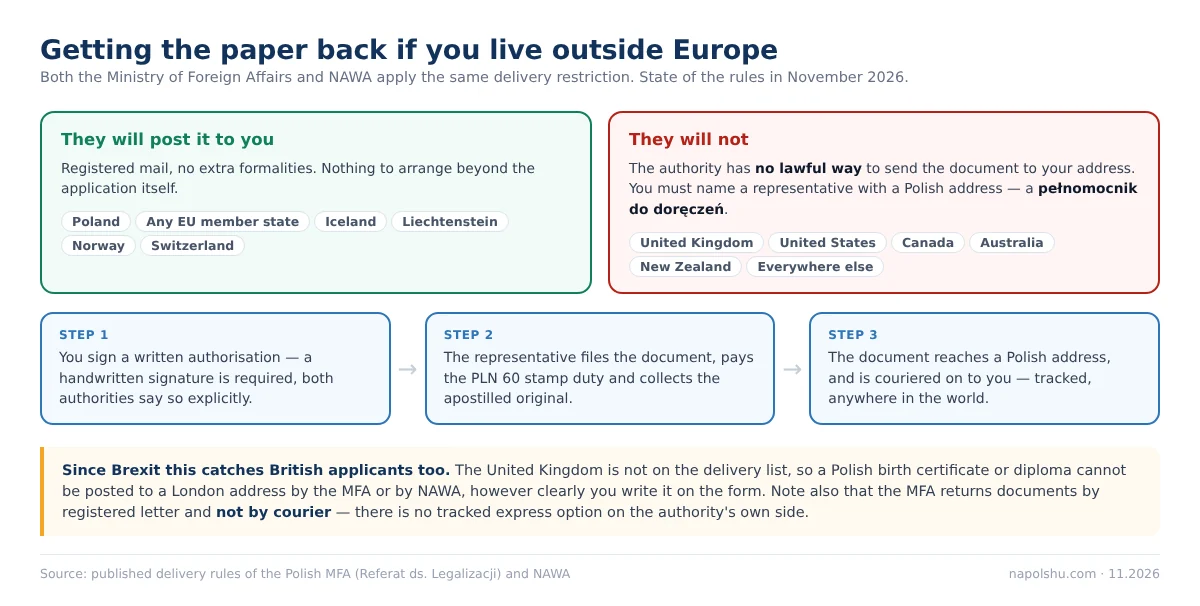
| Your address | Will the authority post it to you | What you need |
|---|---|---|
| Poland | yes, registered mail | nothing extra |
| Any EU member state | yes, registered mail | nothing extra |
| Iceland, Liechtenstein, Norway, Switzerland | yes, registered mail | nothing extra |
| United Kingdom | no | a representative with a Polish address |
| United States, Canada, Australia, New Zealand | no | a representative with a Polish address |
| Everywhere else | no | a representative with a Polish address |
Two further details from the same rules. The MFA returns documents by registered letter and not by courier, so there is no tracked express option on the authority's side at all. And a third party filing on your behalf needs a written authorisation bearing your handwritten signature — this is the mechanism both authorities describe, and it is how we act for clients who are not in Poland.
Both authorities say they do not work with intermediaries. That is worth understanding rather than ignoring: it means neither the MFA nor NAWA has agency accounts, priority queues or commercial arrangements, and nobody can buy you a faster slot. What they do accept is a named person acting under your written authorisation — which is exactly what we are. Anyone promising privileged access is selling something that does not exist.
Tell us the document and the country — we will price it in 15 minutes
We will say which authority it goes to, whether it needs certifying first, whether you need an apostille at all, and how the paper reaches you if you are outside Europe.
How the procedure runs, step by step
Four steps at the Ministry of Foreign Affairs, five if the document needs certifying first. None of them can be done entirely online: the original has to be physically present at the counter or in the envelope.
- Check the document. It needs the issuing office's seal, the signature of an authorised official and that official's named stamp. A KRS extract needs the seal of Centralna Informacja KRS; a CEIDG extract needs the ministry seal.
- Obtain prior certification where the document requires it — the sąd okręgowy for notarial and court papers, a chamber of commerce for trade documents.
- Pay the PLN 60 stamp duty by bank transfer before filing, titled "opłata skarbowa za wydanie apostille", or in cash at the Warsaw city cash desk or a post office. Cash cannot be paid at the ministry itself and must not be posted with the application.
- File the document. In person at ul. Krucza 38/42 in Warsaw, strictly by appointment through the e-Konsulat system, with a limit of ten documents per person per day — or by post to al. Szucha 23, 00-580 Warszawa, enclosing the original, the application form and the printed payment confirmation.
- Collect the result. In person the apostille is normally issued during the visit. By post it comes back by registered letter, within the addresses listed above.
The conclusion in one line: the only step that can be compressed is the queue, and only by filing in person on a booked slot. Everything else runs at the pace the issuing authority sets.
How long it takes
| Step | Fast case | Slow case |
|---|---|---|
| MFA, in person on a booked appointment | during the visit | depends on slot availability |
| MFA, by post | a few days | up to 30 days from receipt |
| Prior certification at a sąd okręgowy | 1–3 working days | up to two weeks |
| Chamber of commerce certification | 1–3 working days | at the chamber's pace |
| NAWA, university diploma | — | 60 days, statutory |
| Sworn translation | 1–2 working days | up to a week for a rare language |
| Our express service | 24 hours | not available where prior certification is needed |
The NAWA row is the one to plan around. Sixty days is not a queue that can be jumped; it is the term written into the procedure, and the agency will not even answer a status query before it expires. If a foreign employer, licensing board or university has given you a deadline, count backwards from it today.
Why there is no e-Apostille in Poland
Poland issues apostilles on paper only. The Polish apostille is a printed sticker carrying a hologram, an official seal and an official's handwritten signature, affixed to the original document. There is no electronic apostille and no electronic register lookup to offer a foreign institution instead.
That has three practical consequences, and all three surprise people who are used to countries that have gone digital:
- No apostille on a copy, a scan or an ePUAP printout. The authorities state this explicitly and repeat it for every document category. A printout of an electronic document is not the document.
- The original has to travel. Booking and forms can be done online, but the paper itself must reach the counter or the post room.
- A digitally issued document may have to be reissued on paper first. If your Polish document exists only as a signed electronic file, you need a paper version from the issuing office before an apostille is possible at all.
Bringing a foreign document into Poland
The apostille on a foreign document is issued by that country's own competent authority — never by Poland. Poland cannot apostille a British, American or Indian document, and no Polish office will do it for you. The direction of travel decides who you deal with.
| Issued in | Apostille needed for Poland | Sworn translation into Polish |
|---|---|---|
| An EU member state, civil status or criminal record | no — Regulation (EU) 2016/1191 | yes, or a multilingual standard form |
| An EU member state, corporate or notarial document | yes | yes |
| The United Kingdom | yes, from the FCDO | yes |
| The United States | yes, from the Secretary of State of the issuing state, or the federal authority | yes |
| Canada, Australia, New Zealand | yes, from that country's designated authority | yes |
| A country outside the Hague Convention | no — consular legalisation instead | yes |
The translation rule has no useful exceptions: it must be made by a sworn translator on the register kept by the Polish Ministry of Justice. A certified translation produced in the country of origin, however elaborately stamped, is routinely refused — and the apostille does nothing to change that, because it certifies the signature on the original, not the translation attached to it.
Sworn translation: when, in what order, by whom
Apostille first, translation second. If the translation is made before the apostille, the apostille lands on the original afterwards and never appears in the translated text — so the receiving institution gets a pack where one of the two documents is untranslated, and treats it as incomplete.
The reverse order is correct in exactly one situation: when the receiving institution wants the apostille placed on the translation itself. Then the chain runs translation, then apostille on the translation — and note that a sworn translation is one of the document types the MFA apostilles directly, at the same PLN 60.
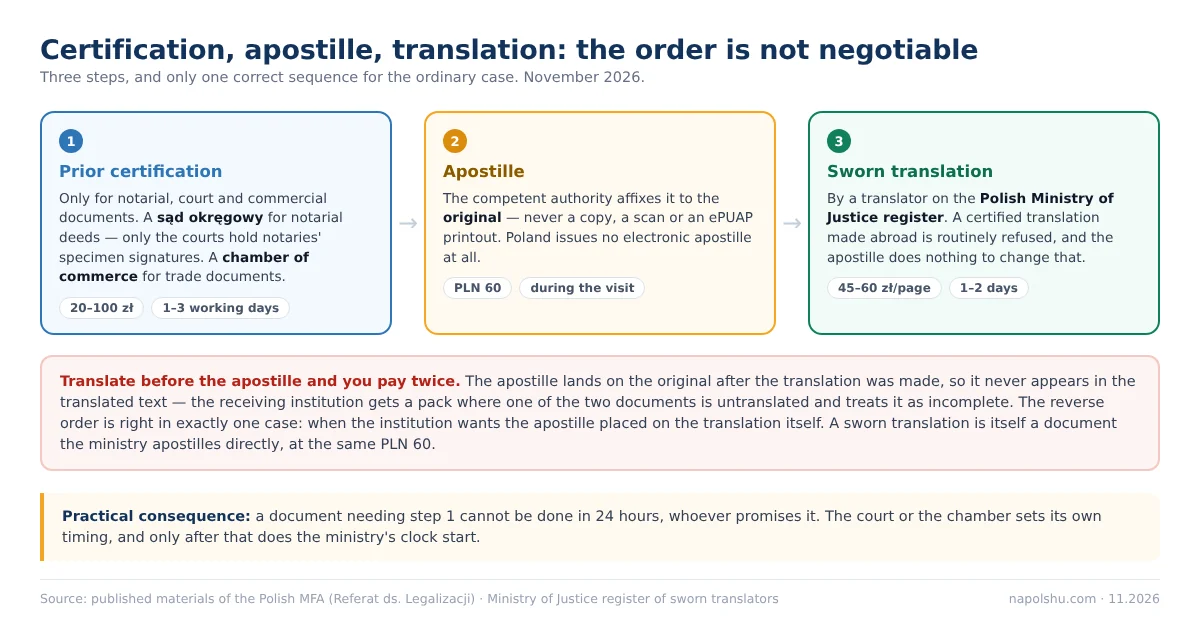
| Sequence | When it is right | What goes wrong otherwise |
|---|---|---|
| Document → apostille → sworn translation | the usual case | — |
| Document → sworn translation → apostille on the translation | the institution wants the translation itself apostilled | a second PLN 60 if both are needed |
| Certification → apostille → translation | notarial, court and commercial documents | the apostille is refused without the prior certification |
| Translation before the apostille, by default | never a safe default | the apostille is not in the translation; a second translation is needed |
Apostille or consular legalisation
An apostille works only between countries party to the Hague Convention of 1961. For everywhere else the route is consular legalisation, which has two stages instead of one. The MFA certifies the document first, then the receiving country's embassy in Poland certifies the MFA's certification.
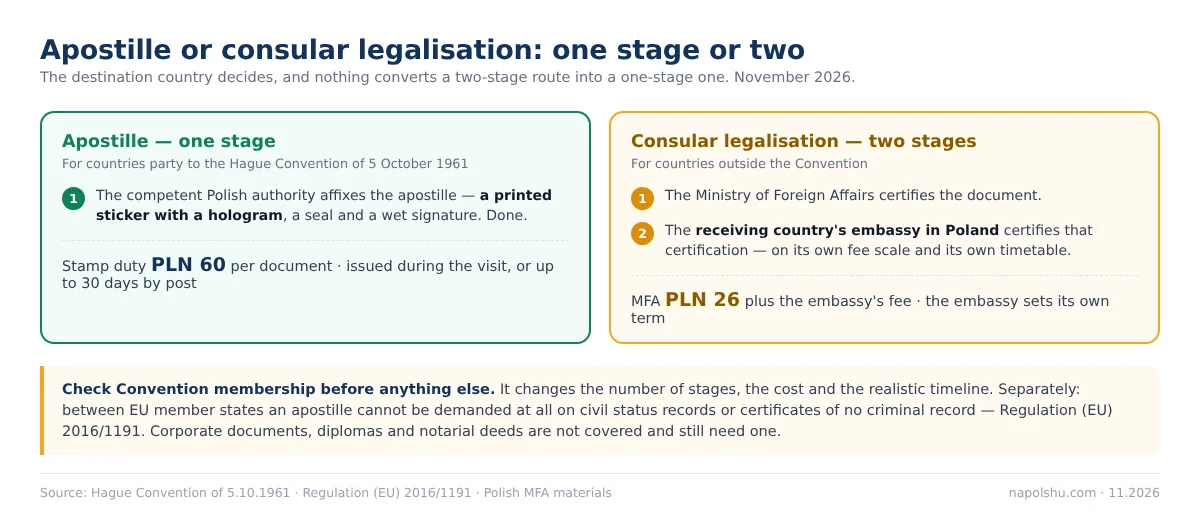
| Apostille | Consular legalisation | |
|---|---|---|
| Applies to | Hague Convention countries | countries outside the Convention |
| Stages | one — the Polish authority | two — the MFA, then the embassy |
| Charge | PLN 60 | PLN 26 plus the embassy's own fee |
| Timing | visit, or up to 30 days by post | the MFA's term plus the embassy's, which it sets itself |
| Predictability | fixed procedure | depends on the embassy's rules and opening hours |
The conclusion in one line: check whether the destination country is a party to the Convention before anything else — it changes the number of stages, the cost and the realistic timeline, and no amount of paying extra converts a two-stage route into a one-stage one.
Why applications come back unprocessed
| Mistake | Consequence |
|---|---|
| Sending a photocopy, a scan or an ePUAP printout | refused: the apostille goes on the original only |
| Sending a diploma to the MFA | returned: university documents go to NAWA |
| Expecting express on a document that needs prior certification | impossible: the court or chamber sets its own timing |
| Giving a non-European address for the return | the document is not posted; a Polish representative is required |
| A KRS extract without the Centralna Informacja seal | refused: the ministry cannot verify the source |
| Paying the stamp duty at the ministry on the day | not possible: payment must be made before filing and evidenced |
| Enclosing cash with a postal application | refused and returned, minus the costs of returning it |
| Translating before the apostille | the apostille is not in the translation; a second one is needed |
| Paying for an apostille on an EU-bound birth or criminal record certificate | wasted: Regulation (EU) 2016/1191 removed the requirement |
| Arriving at the MFA without an e-Konsulat appointment | not admitted: visits are by appointment only |
The fourth row deserves its own sentence, because it is the one that strands people. You can do everything correctly, pay the right fee and file the right document — and still never receive it, because the authority has no lawful way to send it to a London, New York or Sydney address. That is not a service failure; it is the rule, and the only fix is a representative in Poland.
How we work and what it costs
- We start with the document and the destination country. Together they decide the authority, whether an apostille is needed at all, and whether express is even possible.
- We check the document against the issuing authority's requirements — seals, named stamps, the Centralna Informacja mark on a KRS extract.
- We obtain the prior certification at the sąd okręgowy or the chamber of commerce where the document needs it.
- We pay the stamp duty and file, in person on a booked slot, acting under your written authorisation.
- We collect the apostilled original and, where you want it, arrange the sworn translation in the right order.
- We send it to you — including to the countries Polish authorities will not post to, because the document is delivered to our Polish address first.
| Service | Price | Timing |
|---|---|---|
| Apostille, turnkey, per document | PLN 249 | 2–4 working days |
| Apostille, express | PLN 449 | 24 hours |
| Document retrieval in Poland | PLN 350 | 3–10 working days |
| Apostille on a retrieved document | PLN 249 on top | added to the above |
| Stamp duty | PLN 60 | included in our price |
| Sworn translation | PLN 45–60 per page | quoted by language |
| Apostille on a university diploma through NAWA | on request | 60 days, statutory |
The price is fixed before the work starts and does not change during it, and we take no advance payment. If your document turns out not to need an apostille, we say so before you pay — that conversation happens about as often as the opposite one.
Fifteen minutes to settle the whole route
Name the document and where it is going. We will tell you the authority, the realistic timeline, whether an apostille is needed, and how the paper reaches you.
What these Polish names mean
Polish authority names are not translated on forms, in correspondence or on the apostille itself. These are the ones you will meet in the first week.
| Name | What it is | Role here |
|---|---|---|
| MSZ | Ministerstwo Spraw Zagranicznych | the Ministry of Foreign Affairs; apostilles most documents |
| Referat ds. Legalizacji | the MFA's legalisation unit | the actual counter, ul. Krucza 38/42 in Warsaw |
| NAWA | Narodowa Agencja Wymiany Akademickiej | apostilles Polish university documents, ul. Polna 40 |
| USC | Urząd Stanu Cywilnego | the civil registry office; issues birth, marriage and death records |
| KRK | Krajowy Rejestr Karny | the criminal records register |
| KRS | Krajowy Rejestr Sądowy | the court register of companies; extracts need the Centralna Informacja seal |
| CEIDG | Centralna Ewidencja i Informacja o Działalności Gospodarczej | the register of sole traders |
| sąd okręgowy | regional court | certifies notarial and court documents before the apostille |
| KIG | Krajowa Izba Gospodarcza | the national chamber of commerce; certifies trade documents |
| e-Konsulat | the MFA booking system | the only way to get an appointment for an apostille |
| ePUAP | the government e-services platform | a printout from it is never apostilled |
| pełnomocnik do doręczeń | representative for service of documents | required if your address is outside Europe |
Further reading
- Polish criminal record certificate — the document most often sent for an apostille
- Changes in the KRS — where the Centralna Informacja seal on an extract comes from
- The PESEL number for foreigners — the identifier behind most Polish civil-status records
- A bank account for a Polish company — where apostilled corporate documents are asked for
- The EORI number — customs papers, which are never apostilled
- Price list — every service and what it costs
Frequently asked questions
How much does an apostille cost in Poland in 2026?
The stamp duty is PLN 60 per document at the Ministry of Foreign Affairs, paid by transfer before filing. Consular legalisation costs PLN 26 plus the embassy's own fee. Our turnkey service is PLN 249 per document including the stamp duty and courier, or PLN 449 for the 24-hour express.
Who issues the apostille in Poland?
The Ministry of Foreign Affairs for most documents, but not all. University diplomas go to NAWA, school certificates to the education authorities, art-school documents to the Ministry of Culture. Notarial, court and commercial documents reach the ministry only after another body has certified them.
How long does an apostille on a Polish university diploma take?
Sixty days from the day NAWA registers a complete set. The term is statutory, there is no express option, and NAWA will not answer status questions before it expires. Competence moved from the ministries to NAWA on 1 February 2018; anything correctly certified before then does not need redoing.
Can an apostille be placed on a copy or a scan?
No. The apostille goes on the original document bearing the issuing office's seal, an official's signature and a named stamp. Polish authorities state explicitly that no apostille is placed on a photocopy or on a printout from the ePUAP platform. Poland issues no electronic apostille at all.
Will the ministry post my apostilled document to the UK or the US?
No. Polish authorities return documents by registered post only to Poland, the EU, Iceland, Liechtenstein, Norway and Switzerland. Applicants living anywhere else must name a representative with a Polish address to receive it. Since Brexit this includes the United Kingdom.
Do I need an apostille for a document going to another EU country?
Not for civil status records or a certificate of no criminal record: Regulation (EU) 2016/1191 removed that requirement between member states, and a multilingual standard form can replace the translation. Corporate documents, diplomas and notarial deeds are not covered and still need one.
What is the difference between an apostille and consular legalisation?
An apostille is one stage and works between Hague Convention countries. Consular legalisation is two: the Ministry of Foreign Affairs certifies the document, then the receiving country's embassy in Poland certifies that certification. It costs PLN 26 plus the embassy's fee and runs on the embassy's timetable.
Can I get an apostille without being in Poland?
Yes, through a representative acting under a written authorisation bearing your handwritten signature — the mechanism both the ministry and NAWA describe. The representative files the document, pays the duty and collects the result. For applicants outside Europe this is the only workable route.
Are invoices and shipping documents apostilled?
No. Documents relating directly to commercial transactions or customs operations — invoices, bills of lading, shipping papers — are excluded from the apostille procedure altogether. Where a counterparty asks for one, what they usually need is certification by a chamber of commerce instead.
This page is for information only and does not replace individual legal advice. Charges, deadlines and procedures are stated as at November 2026.
Author: Marta Kowalik, lawyer at napolshu.com. Verified on 20 November 2026. Sources: the Hague Convention of 5 October 1961; Regulation (EU) 2016/1191 of the European Parliament and of the Council; the Polish Stamp Duty Act; published materials of the Ministry of Foreign Affairs, Referat ds. Legalizacji, and of the Narodowa Agencja Wymiany Akademickiej (NAWA).
